 09/23 ,2026
 Restaurants, bakeries, caterers, and meal-prep businesses often ask the same question: blast chiller vs shock freezer—which machine should they buy? A blast chiller for restaurant food safety is designed mainly for rapid cooling, while a commercial shock freezer for catering drives food below the freezing point. This blast freezer buying guide compares HACCP procedures, cold-chain control, sensible heat, latent heat, and nucleation so buyers can match equipment to real production needs rather than rely on marketing claims.
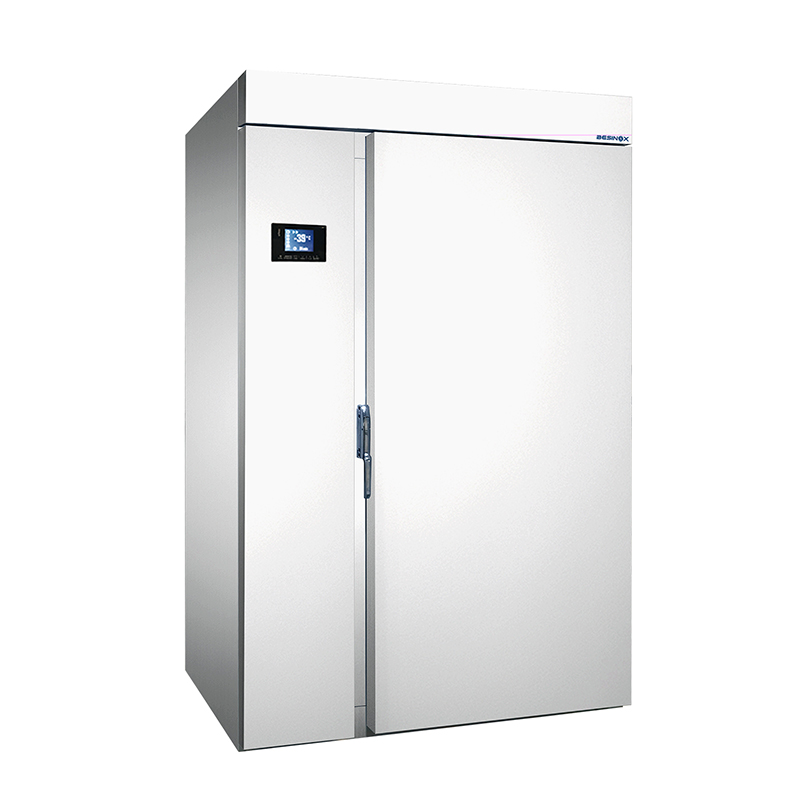
A blast chiller and a shock freezer are related pieces of commercial refrigeration equipment, but they do not perform the same job. Both use high-velocity cold air and forced convection to remove heat faster than a standard refrigerator or freezer. The difference is the target temperature, operating range, product outcome, and production purpose.
A blast chiller rapidly lowers the temperature of cooked food without intentionally freezing the product. Its primary purpose is to move food through the bacterial “danger zone” quickly and safely. In many food-service procedures, cooked food is cooled from approximately 57°C/135°F to 21°C/70°F within 2 hours, and then to 5°C/41°F or below within a total of 6 hours, consistent with widely used U.S. Food Code cooling controls.
Many commercial blast chillers are designed to cool food to approximately 0°C to 3°C, depending on the product and the manufacturer’s program. The food can then be stored in a refrigerator, transported under controlled conditions, or used for later service.
A shock freezer, also called a blast freezer in some markets, operates at lower air temperatures and is intended to freeze food rapidly. Typical cabinet air temperatures may range from approximately -30°C to -40°C, while the product’s core temperature is commonly brought to -18°C or lower.
Rapid freezing creates smaller ice crystals than slow freezing. Smaller crystals generally cause less cellular damage, which can improve the texture of vegetables, sauces, seafood, pastry fillings, and prepared meals after thawing. The actual result depends on food composition, package thickness, water activity, loading density, and final core temperature.
| Parameter | Blast Chiller | Shock Freezer | Why It Matters |
|---|---|---|---|
| Primary purpose | Rapidly cool cooked or hot food | Rapidly freeze food | Choose according to whether the product will be refrigerated or frozen |
| Typical cabinet air temperature | Approximately -5°C to -10°C, depending on the program | Approximately -30°C to -40°C | Lower air temperature increases freezing capacity but also raises energy and compressor requirements |
| Typical product target | About 0°C to 3°C | Usually -18°C or lower at the core | Core temperature, not air temperature, determines process completion |
| Freezing intended? | No, although some models offer a freezing cycle | Yes | A chiller-only unit may not provide sufficient pull-down performance for frozen storage |
| Typical process duration | Approximately 60–120 minutes for shallow trays, depending on load | Approximately 90–240 minutes for many prepared foods, depending on thickness and load | Time varies significantly with product mass, packaging, tray depth, and starting temperature |
| Best product format | Soups, sauces, cooked meats, rice, vegetables, pastries | Prepared meals, seafood, meat, dough, desserts, high-value ingredients | Products with high water content benefit from rapid crystal formation |
| Food-quality objective | Reduce bacterial growth time and preserve freshness | Limit ice-crystal size and extend frozen shelf life | Rapid cooling and rapid freezing solve different quality problems |
| Storage after cycle | Refrigerator, usually 0–5°C | Freezer, commonly -18°C or below | Existing cold-storage capacity must match the machine’s output |
| Typical electrical demand | Lower than a dedicated shock freezer in many configurations | Higher refrigeration capacity is normally required | Confirm voltage, phase, breaker size, heat rejection, and peak demand |
The values above are practical industry ranges rather than universal guarantees. A manufacturer should validate performance using the buyer’s actual food, tray type, package dimensions, starting temperature, and required core-temperature endpoint.
Understanding the heat-transfer process helps explain why the two machines are not interchangeable.
Sensible heat is the energy removed when food temperature falls without changing physical state. For example, cooling soup from 90°C to 3°C mainly involves sensible heat removal. The approximate energy load can be estimated using:
Q = m × Cp × ΔT
where Q is heat energy, m is product mass, Cp is specific heat capacity, and ΔT is the temperature change.
When water inside food changes from liquid to ice, the process also involves latent heat. This requires substantially more refrigeration work. That is why freezing a 20-kilogram batch requires more capacity than merely cooling the same batch from 80°C to 3°C.
During freezing, nucleation is the formation of initial ice crystals. Slow freezing allows fewer crystals to grow larger. Rapid freezing encourages many smaller crystals, which can reduce mechanical damage to cell walls. However, rapid freezing does not eliminate all quality loss. Repeated temperature fluctuations during storage can cause recrystallization, producing larger crystals even when the original freezing cycle was well controlled.
A restaurant producing soup, curry, braised meat, rice, or sauces for next-day service will usually benefit more from a blast chiller. The equipment can shorten the time food spends in the microbial growth range, improve portioning flexibility, and reduce the need to leave hot stock in a large refrigerator where it may raise the cabinet temperature.
For example, a 30-liter pot of sauce should not be placed directly into a refrigerator as one deep container. Dividing it into shallow pans and using a probe-controlled blast-chilling cycle improves heat transfer. The operator must still verify the product core temperature and maintain a written cooling record.
Bakeries often need both functions. A blast chiller can cool baked fillings, custards, and cooked fruit preparations. A shock freezer is more appropriate for frozen dough, mousse cakes, semifreddo, ice cream components, and products that must be stored for weeks.
For a bakery selling frozen entremets, a shock freezer can reduce the time required for the product to pass through the maximum ice-crystal-growth zone. This can help preserve a smoother mousse structure after thawing, although recipe formulation and stabilizer selection remain equally important.
Caterers frequently need a two-stage workflow: blast chill cooked food for short-term refrigerated distribution, or shock freeze meals for longer storage and scheduled delivery. A combination unit may be practical for smaller operations, while a separate chiller and freezer generally provide higher throughput when both processes occur at the same time.
Before buying, calculate daily production in kilograms, batch size, tray dimensions, average starting temperature, target core temperature, and the number of cycles available between service periods. A machine rated for 20 kilograms per cycle may not achieve that result when food is packed in deep containers or loaded above the recommended spacing.
Purchase price varies by capacity, refrigeration system, stainless-steel construction, control technology, certification, and local installation requirements. The following broad USD ranges are planning estimates, not quotations:
| Equipment category | Approximate equipment price | Typical buyer | Additional cost factors |
|---|---|---|---|
| Small countertop or undercounter blast chiller | Approximately $3,000–$8,000 | Cafés, small restaurants, pastry shops | Electrical work, ventilation, probe accessories, delivery |
| Medium commercial blast chiller | Approximately $8,000–$20,000 | Restaurants, hotels, catering kitchens | Capacity, compressor type, rack system, monitoring software |
| Commercial shock freezer | Approximately $10,000–$35,000 or more | Industrial bakeries, food manufacturers, central kitchens | Lower operating temperature, refrigeration capacity, insulation, installation |
| Blast chiller/shock freezer combination | Approximately $12,000–$40,000 or more | Operations requiring both chilled and frozen production | Control flexibility, cycle overlap, maximum load, service support |
Total cost of ownership includes electricity, preventive maintenance, refrigerant compliance, door-gasket replacement, calibration of temperature probes, cleaning labor, and downtime risk. A cheaper unit that cannot meet the required batch capacity may cost more per usable kilogram than a higher-capacity machine.
Because performance depends heavily on food thickness and loading, online reviews should be interpreted carefully. A buyer reporting “the machine is slow” may be using 100-millimeter-deep containers, while another reporting a 60-minute cycle may be using shallow 20-millimeter trays.
Consider a restaurant producing 40 kilograms of tomato sauce for the following day. The kitchen divides the sauce into shallow stainless-steel pans, places them with adequate spacing in a blast chiller, and inserts a core probe into the thickest pan. The relevant success measure is not simply the displayed air temperature; it is whether the center of the product reaches the documented safety target within the required time and remains below 5°C during storage.
This workflow can reduce refrigerator heat load and make batch preparation more predictable. It does not remove the need for hygienic handling, clean containers, accurate labeling, and refrigerated storage.
A pastry team preparing frozen mousse cakes needs the product to become firm enough for demolding and packaging without creating a coarse frozen structure. A shock freezer is more suitable because it supplies a lower-temperature environment and greater freezing capacity than a standard blast chiller. The team should still monitor core temperature, packaging temperature, freezer loading, and the thawing procedure.
When evaluating BEU or another commercial blast chiller manufacturer, compare measurable specifications rather than general claims. Ask for:
A manufacturer that provides test conditions and limitations is easier to compare objectively than one that publishes only a maximum capacity number.
Select a blast chiller when most of your production involves:
Select a shock freezer when your operation requires:
A combination blast chiller/shock freezer can suit a small or medium operation with limited floor space and mixed production. It may be less suitable for a high-volume factory where chilling and freezing must occur simultaneously. In that situation, separate units usually provide clearer capacity planning and reduce scheduling conflicts.
A blast chiller and a shock freezer are not the same. A blast chiller is the better choice for rapidly reducing cooked food to refrigerated temperatures and supporting HACCP cooling controls. A shock freezer is the better choice for bringing food to frozen-storage temperatures and limiting damage from large ice crystals. Buyers who need both processes should compare a combination unit with two dedicated machines based on kilograms per cycle, core-temperature results, available floor space, electrical capacity, and after-sales service.
For the next step, list your average batch weight, tray depth, starting temperature, required endpoint, cycles per day, and storage temperature. Then ask BEU or another qualified commercial blast chiller manufacturer to provide a documented load test using your actual product. This approach is more reliable than choosing by cabinet size alone. For anyone researching a blast chiller vs shock freezer for restaurant, a best commercial blast chiller for catering, or a blast freezer buying guide, the key LSI considerations remain HACCP compliance, cold-chain management, and food-quality retention, supported by the professional concepts of sensible heat, latent heat, and nucleation.
No. A blast chiller mainly cools hot food to approximately 0°C–3°C, while a shock freezer rapidly freezes food to a core temperature commonly around -18°C or lower. Some combination units offer both programs, but their cooling and freezing capacities should be verified separately.
Some blast chillers include a freezing cycle, but not every model is designed for intensive freezing. Check the manufacturer’s stated air temperature, freezing capacity, core-temperature performance, and maximum load. A chiller that reaches 0°C efficiently may not reach -18°C throughout a dense product.
Technically, many shock freezers can cool food, but using a lower-temperature freezer for routine chilling may increase energy use and may not provide the most appropriate control profile. Confirm that the unit has a dedicated chilling program and that the manufacturer approves the application.
Many shallow-tray products can reach refrigerated temperature in approximately 60–120 minutes, but the actual time depends on mass, thickness, water content, container material, airflow, loading density, and starting temperature. Always verify the thickest point with a calibrated probe.
Rapid freezing may take approximately 90–240 minutes for many prepared foods, but dense or heavily packaged products can require longer. The cycle is complete only when the product core reaches the specified target, not when the cabinet display first reaches its set temperature.
It can. Faster freezing generally produces smaller ice crystals, which may reduce texture damage after thawing. However, recipe formulation, packaging, storage temperature, freezer stability, and thawing control also affect the final result.
Start with peak batch weight rather than average daily production. If a restaurant must cool 40 kilograms in one service window, compare machines using a validated 40-kilogram load in the intended containers. Allow additional capacity for future growth and avoid loading food so tightly that airflow is blocked.
The most useful specification is validated product-core performance under stated test conditions. Compare kilograms per cycle, endpoint temperature, cycle time, tray configuration, ambient temperature, electrical consumption, warranty, and service support together rather than selecting only by price.
To visit Guangzhou BEU Electric Appliance Co., Ltd. (called as BEUEA below) website, you are agreeing the terms and conditions within this policy.
BEUEA respects your privacy and will protect your information remains confidential.
We will not lease, sell, or rent your information to the third party for their independent use under any circumstances.