 08/06 ,2026
 Choosing between a blast chiller and a walk-in cooler can determine whether a restaurant safely cools a 20 kg batch of soup or leaves it in the bacterial growth range for hours. This blast chiller vs walk-in cooler for rapid cooling guide compares the best commercial blast chiller for restaurants, expected blast chiller cooling time for cooked food, and practical rapid cooling equipment requirements. It also explains walk-in refrigeration, food safety temperature control, and professional concepts such as HACCP, thermal recovery, and the microbial growth zone so operators can select equipment based on measured performance rather than marketing adjectives.

Many kitchens use a walk-in cooler as both storage space and a cooling tool. The problem appears after cooking: a deep container of rice, sauce, stock, curry, or meat may remain warm in the center long after its surface feels cold. A walk-in cooler is designed primarily to maintain already-chilled products, whereas a blast chiller is designed to remove heat from hot food quickly.
The distinction matters because many food-safety systems require cooked food to cool from approximately 57°C to 21°C within two hours and from 21°C to 5°C within a further four hours, depending on the applicable local food code. The U.S. FDA Food Code uses this two-stage cooling target. Local regulations may vary, so the operator should confirm requirements with the local authority.
For a restaurant serving 150 to 500 meals daily, the central question is not simply “Which unit is colder?” It is:
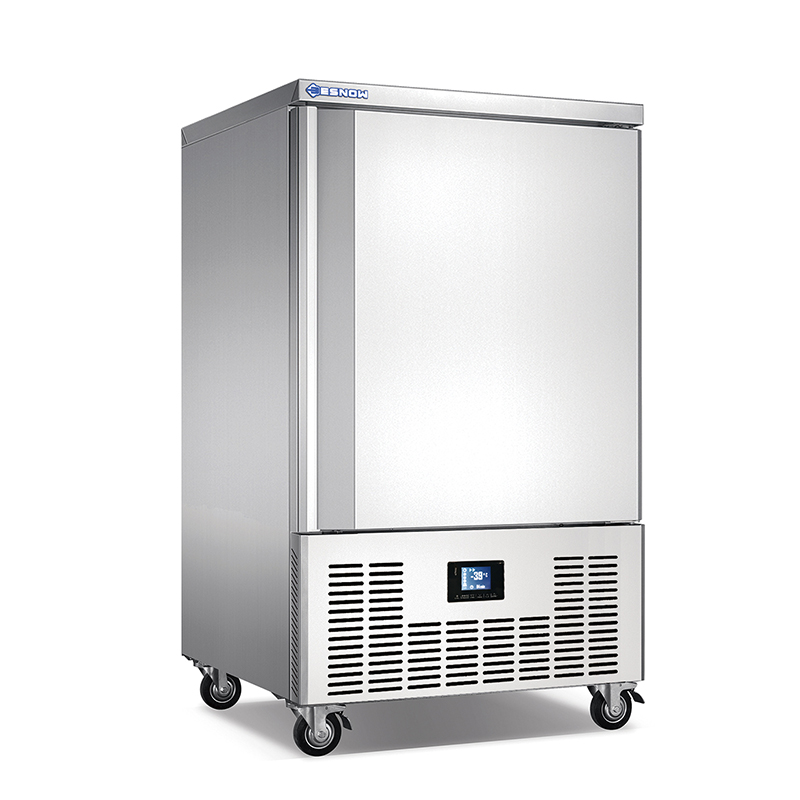
A blast chiller uses high-velocity, low-temperature air to transfer heat from food into the evaporator system. Depending on the model, air temperature may reach approximately -20°C to -40°C during the pull-down cycle, while air circulation helps reduce the boundary layer around trays and pans.
Typical commercial blast chillers are designed to cool food from about 70°C to 3°C or 5°C in approximately 90 to 240 minutes, depending on:
For example, a 25 mm-deep pan of soup cools substantially faster than a 100 mm-deep pan because the heat has a shorter path to travel. A blast chiller does not eliminate the need for portioning, probe checks, or written records; it makes compliance more achievable when the loading method is correct.
A walk-in cooler generally operates at approximately 0°C to 5°C for chilled food storage. Its evaporator and fan system are optimized to maintain the cabinet temperature after products have already been cooled. When hot food is loaded, several limitations appear:
A walk-in cooler remains essential for storage, but it is not automatically a substitute for a blast chiller. The equipment has different design priorities: a blast chiller is a process machine, while a walk-in cooler is primarily a holding and distribution system.
| Parameter | Commercial Blast Chiller | Walk-In Cooler |
|---|---|---|
| Primary purpose | Rapidly cool hot food before storage | Store food that is already chilled |
| Typical operating range | Approximately -40°C to +5°C, depending on cycle | Approximately 0°C to +5°C |
| Typical cooling target | 70°C to 3°C or 5°C in approximately 90–240 minutes | Not normally specified for rapid hot-food cooling |
| Air movement | High-velocity airflow directed around trays | Moderate airflow designed for room temperature stability |
| Batch capacity | Commonly 5–100 kg, depending on model | Large total storage volume, but slower hot-food pull-down |
| Temperature control | Food probe, timed cycles, and programmable controls on many models | Room thermostat; food-core monitoring is usually manual |
| Best use | Cook-chill production, catering, meal preparation, bakeries | Receiving, storage, staging, and finished-product holding |
| Risk when overloaded with hot food | Longer cycle and possible capacity limitation | Temperature rise affecting all stored products |
| Installation needs | Electrical capacity, ventilation clearance, condensate management | Floor space, insulated panels, refrigeration system, drainage |
| Relative purchase cost | Often lower for a small cabinet; higher for large production units | Usually higher total project cost because of room construction |
A blast chiller is generally the stronger choice when a business cooks large quantities in advance. Suitable applications include:
For example, if a kitchen prepares 60 kg of tomato sauce at 85°C and divides it into shallow pans, a correctly sized blast chiller can reduce the cooling period significantly compared with placing the same deep pots in a walk-in cooler. The exact result must be verified with a calibrated probe at the thickest point.
A walk-in cooler may be the better first purchase when the business mainly needs:
A small café that cooks only 10 to 15 kg of food per day may obtain more operational value from a properly sized walk-in cooler, shallow pans, ice baths, and documented cooling procedures. However, if the same café begins producing 80 kg of prepared meals for delivery, the calculation changes.
High-volume food operations often need both systems. The blast chiller handles the high-heat process step, and the walk-in cooler provides storage after the food reaches the target temperature. Using the walk-in cooler for both tasks can create a bottleneck during batch production and service preparation.
A practical workflow is:
Prices vary by country, capacity, compressor type, insulation, certification, and installation conditions. The following ranges are planning estimates rather than quotations:
| Equipment category | Indicative equipment price | Typical cost factors |
|---|---|---|
| Small 5–10 tray blast chiller | Approximately US$4,000–US$12,000 | Tray capacity, probe control, compressor, voltage |
| Medium 10–20 tray blast chiller | Approximately US$8,000–US$25,000 | Cooling capacity, remote condensing unit, controls |
| Large blast chiller or freezer system | Approximately US$20,000–US$80,000+ | Production throughput, custom installation, freezing function |
| Small walk-in cooler | Approximately US$10,000–US$25,000 installed | Panel size, floor, refrigeration, electrical work |
| Medium or large walk-in cooler | Approximately US$20,000–US$70,000+ | Room dimensions, doors, shelving, refrigeration load |
Purchase price alone can produce a misleading result. Buyers should calculate:
Cost per cooled kilogram = equipment and installation cost ÷ expected cooled kilograms during the equipment’s service life.
Also include electricity, maintenance, cleaning labor, downtime, refrigerant service, and food waste. A blast chiller costing US$15,000 may be financially sensible if it prevents 30 kg of discarded prepared food each week. At a food cost of US$4 per kilogram, that waste equals approximately US$6,240 per year before labor and disposal costs.
In an anonymized kitchen production review, a catering operator reported that cooling 40–50 kg batches of cooked rice and sauce in a walk-in cooler created inconsistent core temperatures. The operator changed to shallow pans and a dedicated blast chiller, then recorded each batch with a calibrated probe. The practical improvement was not described as “instant cooling”; the key result was that the batches reached the company’s cooling target within its documented control window more consistently.
A second operator running a small restaurant reported the opposite experience: the business purchased a blast chiller before estimating its daily production volume. Because the kitchen cooled fewer than 12 kg of food per day, the unit was underused, while the restaurant still lacked adequate storage space. In that case, a walk-in cooler and improved pan depth would have addressed the more urgent problem.
These cases illustrate why online reviews should be read carefully. Positive feedback often relates to:
Negative feedback frequently results from overloading, poor tray spacing, unsuitable electrical supply, inadequate ventilation, or buying a unit smaller than the production requirement. A fair evaluation should distinguish equipment defects from incorrect application.
When comparing BEU with other commercial blast chiller manufacturers, buyers should request measurable information rather than relying only on terms such as “super powerful” or “ultra-fast.” Ask each supplier for:
BEU can be considered on a shortlist when its capacity, test data, configuration, and after-sales support match the buyer’s operating conditions. The important comparison is not whether one brand claims to be faster; it is whether the proposed model can cool the buyer’s actual product load to the required core temperature within the required time.
Select a blast chiller if the kitchen regularly cools more than 20–30 kg of cooked food per production cycle, supplies multiple locations, or must maintain formal HACCP records. Prioritize probe control, batch capacity, service support, and published performance data.
Select a walk-in cooler if the primary problem is insufficient refrigerated storage, not hot-food cooling. The unit should be sized around delivery volume, shelf life, aisle clearance, door openings, and the heat load of incoming products.
For hospitals, hotels, meal-delivery companies, and central production kitchens, separate process cooling from storage. This arrangement reduces competition between hot-food cooling and refrigerated inventory and supports clearer temperature-control records.
A compact blast chiller can be appropriate when floor space is limited but the business still produces sauces, desserts, prepared meals, or sous-vide products. Confirm that the cabinet can accept the existing pan dimensions and that the electrical supply is suitable.
Even a correctly specified unit may fail to deliver the expected result if it is used incorrectly. Avoid these common errors:
Food texture also matters. Blast chilling can preserve color, moisture, and structure, but excessive airflow or freezing temperatures may damage delicate products. Test representative recipes before setting a standard operating procedure.
Usually not for high-volume rapid cooling. A walk-in cooler can cool small, shallow portions under controlled conditions, but it is primarily designed for storage. The operator must validate the actual food-core cooling time rather than assume compliance.
Many commercial models are rated to cool food from approximately 70°C to 3°C or 5°C in 90–240 minutes. The actual result depends on food density, pan depth, load size, airflow, starting temperature, and ambient conditions.
Some models provide both blast-chilling and blast-freezing cycles. Chilling normally targets approximately 0°C to 5°C, while freezing reduces the product temperature substantially below 0°C. Confirm the model’s freezing capacity and whether it is suitable for the intended food type.
Measure the maximum batch produced in one cycle, not the average daily volume. A useful starting point is to select a model that can handle the largest normal batch while leaving enough space for airflow. The supplier should confirm capacity based on the actual tray size and product depth.
Energy use depends on compressor efficiency, cycle duration, insulation, ambient temperature, load, and maintenance. A blast chiller may use more power during a short pull-down cycle than a walk-in cooler uses during a normal holding period, but it can reduce food waste and prevent excessive temperature recovery in the storage room.
Ask BEU for a written technical sheet covering cooling capacity, test conditions, cycle time, electrical requirements, probe accuracy, warranty, spare parts, installation requirements, and after-sales service in your region. Request a recommendation based on your food type, batch weight, pan dimensions, and production schedule.
A blast chiller is suitable for restaurants, caterers, hotels, healthcare kitchens, and central production facilities that need repeatable rapid cooling of cooked food. It is not the best choice when the business mainly needs storage and has little hot-food production. A walk-in cooler is suitable for receiving, holding, and organizing chilled inventory, but it should not be treated as a dedicated rapid-cooling machine for deep or heavy batches.
The most defensible decision is based on measured batch size, required cooling time, available floor space, electrical capacity, local food-code requirements, and five-year operating cost. Compare BEU and other commercial blast chiller manufacturers using verified core-temperature data, service coverage, and total ownership cost. For buyers researching blast chiller vs walk-in cooler for rapid cooling, the best commercial blast chiller for restaurants, and blast chiller cooling time for cooked food, the final selection should also account for rapid cooling equipment, walk-in refrigeration, food safety temperature control, HACCP validation, thermal recovery, and control of the microbial growth zone.
Next step: prepare a one-day production record showing your largest batch weight, starting temperature, pan dimensions, target temperature, and available power supply. Send those details to BEU or another qualified supplier and request a model-specific cooling calculation instead of accepting a generic capacity claim.
To visit Guangzhou BEU Electric Appliance Co., Ltd. (called as BEUEA below) website, you are agreeing the terms and conditions within this policy.
BEUEA respects your privacy and will protect your information remains confidential.
We will not lease, sell, or rent your information to the third party for their independent use under any circumstances.