 08/04 ,2026
 How Blast Chillers Improve Cook-Chill Food Production is a critical question for central kitchens, hotels, hospitals, catering companies, and food manufacturers that need to cool cooked food quickly and safely. With a properly sized BEU blast chiller, you can establish a simple process: portion food correctly, load the cabinet without blocking airflow, verify core temperature with calibrated probes, document the cooling cycle, and transfer products into controlled cold storage. This approach helps reduce food-safety risk, improve shelf-life consistency, lower waste, and increase production capacity.

Cook-chill production separates cooking from service. Food is prepared in batches, rapidly cooled, stored under refrigeration, and reheated or served later.
The operational problem is that cooked food can remain for too long in the temperature danger zone. Large pots, deep containers, sauces, rice, poultry, and prepared meals cool slowly because heat remains trapped at the center.
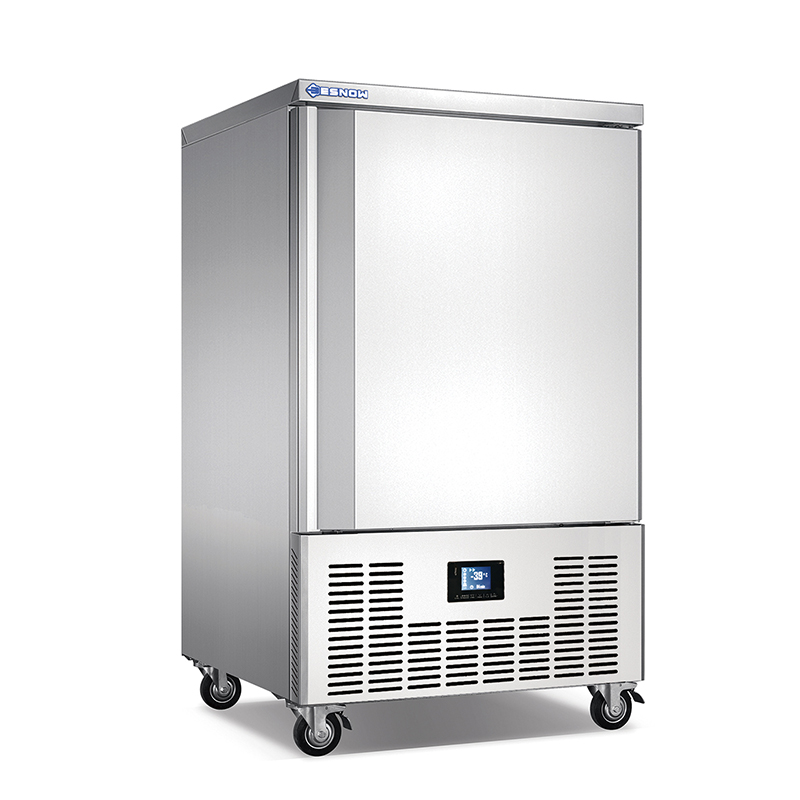
A blast chiller solves this problem by circulating high-velocity refrigerated air around shallow food containers. Unlike a standard refrigerator, it is engineered to remove heat from freshly cooked products quickly.
For many food operations, the target is to cool food from approximately 135°F to 70°F within 2 hours, then from 70°F to 41°F or below within a total of 6 hours, following the cooling framework used in the FDA Food Code. Local regulations may differ, so the site HACCP plan and regulatory requirements must always be followed.
This is why selecting a reliable commercial blast chiller manufacturer is not only an equipment decision. It is a food-safety, workflow, and total-cost-of-ownership decision.
The benefits of How Blast Chillers Improve Cook-Chill Food Production can be measured across food safety, throughput, product quality, and labor efficiency.
A blast chiller rapidly lowers the core temperature of cooked food. Faster cooling limits the time available for microbial multiplication and supports a documented HACCP control point.
The most important measurement is not the air temperature inside the cabinet. It is the core temperature of the food. Operators should use a calibrated penetration probe in the thickest or slowest-cooling section of the product.
Rapid cooling helps preserve:
Fast cooling also reduces the formation of large ice crystals when the unit includes a freezing function. This is particularly valuable for prepared meals, bakery fillings, seafood, and high-value ingredients.
A cook-chill system allows kitchens to produce food during scheduled preparation windows instead of cooking every item immediately before service.
With BEU equipment, a production team can organize workflows around:
This reduces peak-time pressure and enables centralized production for multiple restaurants, wards, schools, or catering locations.
A standard cold room is designed to maintain already chilled food. It is not necessarily designed to remove the heat load from large quantities of freshly cooked food.
Loading hot products into a walk-in refrigerator can:
A blast chiller removes the initial heat load before the food enters long-term refrigerated storage.
The following process provides a practical method for implementing How Blast Chillers Improve Cook-Chill Food Production in a commercial kitchen or food-processing facility.
Before purchasing equipment, record the actual production profile.
Measure:
For example, cooling 40 kg of shallow-packed meals is very different from cooling 40 kg of deep soup containers. A reputable commercial blast chiller manufacturer should size the unit according to product load and thermal performance rather than external cabinet volume alone.
Food depth has a major effect on cooling time. Use shallow GN pans or approved food containers whenever suitable.
Recommended operating practices include:
Always follow the food manufacturer’s process validation and the equipment supplier’s loading instructions.
Do not leave cooked food at room temperature while waiting for the blast chiller to become available.
Transfer food into the cabinet as soon as practical after cooking. Select the appropriate cycle for the product, such as:
The correct cycle depends on product density, container type, batch weight, and loading configuration.
Insert a sanitized probe into the center of the thickest portion. For mixed products, test the location that is expected to cool most slowly.
Record:
Temperature probes should be calibrated according to the site’s food-safety program. A useful verification system may include a daily check, scheduled calibration, and documented tolerance limits.
Once the target temperature is reached, move the product to a refrigerated storage area without delay.
Use proper stock rotation, such as:
Label each container with the product name, production date, use-by date, allergen information, and batch code. The blast chiller is only one part of the cold chain; storage temperatures must also be controlled and recorded.
Conduct validation trials for the most challenging products. Test the heaviest load, densest recipe, deepest container, and highest expected ambient condition.
Review whether:
When comparing BEU with another commercial blast chiller manufacturer, evaluate the complete system rather than focusing only on purchase price.
| Selection factor | What to verify | Why it matters |
|---|---|---|
| Rated batch capacity | Kilograms per cycle and container configuration | Prevents overloading |
| Cooling performance | Time-temperature data under defined conditions | Supports HACCP validation |
| Air circulation | Fan design and airflow distribution | Reduces hot and cold spots |
| Temperature control | Product probe and cabinet sensor functions | Improves process accuracy |
| Construction | Stainless-steel interior, insulation, door seals | Supports hygiene and durability |
| Cleaning design | Removable components and accessible surfaces | Reduces sanitation time |
| Controls | Programmable cycles, alarms, data logging | Improves repeatability |
| Compliance documentation | Test reports, manuals, wiring diagrams | Supports audits and installation |
| Service support | Spare parts and response commitments | Reduces downtime |
| Warranty terms | Coverage, exclusions, and service process | Clarifies lifecycle cost |
For technical benchmarking, ask whether performance testing follows EN 17032, which covers blast chillers and blast freezers for professional use, including performance and environmental test methods. Electrical safety, sanitation, and local certification requirements should also be verified for the destination market. ASTM and DIN references may apply to specific materials, testing methods, or components, but they should not be treated as a substitute for food-equipment certification.
Before placing an order, request:
A professional supplier should be able to explain how the stated performance was measured. Do not rely only on an advertised “fast cooling” claim without asking for actual test conditions.
Equipment quality affects uptime, hygiene, and long-term operating cost. When assessing BEU or another commercial blast chiller manufacturer, look for a documented quality-management process.
Useful evidence may include:
The exact inspection scope should be confirmed with the supplier. A buyer can also request inspection reports, photographs, packing records, and pre-shipment testing documentation.
For a food-processing installation, the documentation package should ideally include:
Even a high-performance blast chiller may fail to deliver expected results if the operating method is incorrect.
Overloading restricts airflow and increases cooling time.
Solution: Follow the rated batch capacity, use the recommended pan arrangement, and validate the slowest-cooling load rather than the easiest test batch.
Deep containers retain heat in the center.
Solution: Use shallow pans, standardize portion depth, and record the container configuration used during validation.
A probe placed near the surface may show a safe reading while the center remains hot.
Solution: Insert the probe into the thickest area and use multiple test points during validation.
Frequent door opening introduces warm, humid air and disrupts the cooling cycle.
Solution: Stage pans before opening the door, load the cabinet efficiently, and keep the door closed during operation.
Food residue, standing water, and damaged seals create sanitation risks.
Solution: Use a written sanitation standard operating procedure. Clean product-contact areas after each production cycle and inspect door gaskets, drain areas, fan guards, and internal corners.
A failed cooling cycle becomes a serious problem when staff do not know what to do next.
Solution: Define actions in advance:
The right tools make cook-chill production more consistent and easier to audit.
Consider using:
For larger facilities, integrating the blast chiller with kitchen production software can connect recipe, batch, temperature, and inventory records. This improves traceability and helps managers identify recurring delays.
To verify whether the investment is producing results, track operational key performance indicators.
Useful metrics include:
A simple baseline comparison can show the effect of How Blast Chillers Improve Cook-Chill Food Production. Record performance for two to four weeks before installation, then compare the same indicators after staff training and process validation.
BEU should be evaluated as a complete equipment and process solution, not simply as a cabinet supplier. The most valuable support comes from matching machine capacity to the customer’s product, providing clear technical documentation, and helping users establish a repeatable operating procedure.
When comparing BEU with another commercial blast chiller manufacturer, focus on:
A well-specified BEU blast chiller can help food businesses reduce cooling bottlenecks while improving cold-chain control and production planning.
Use this checklist to begin:
How Blast Chillers Improve Cook-Chill Food Production becomes clear when the equipment is connected to a disciplined process. BEU blast chillers can support rapid core-temperature reduction, consistent product quality, higher batch throughput, and stronger HACCP documentation when they are correctly sized, loaded, monitored, cleaned, and maintained.
The most effective approach is straightforward: measure your production requirements, select the right BEU capacity, validate the hardest product, train operators, document every cycle, and review performance continuously. By working with a capable commercial blast chiller manufacturer and applying these steps, your business can make cook-chill production safer, more efficient, and easier to scale.
To visit Guangzhou BEU Electric Appliance Co., Ltd. (called as BEUEA below) website, you are agreeing the terms and conditions within this policy.
BEUEA respects your privacy and will protect your information remains confidential.
We will not lease, sell, or rent your information to the third party for their independent use under any circumstances.