 09/18 ,2026
 If you need a blast chiller for HACCP, a commercial blast chiller manufacturer, or rapid cooling equipment for restaurants, the key answer is simple: a blast chiller helps move cooked food through the microbial growth zone under controlled, documented conditions. It supports a HACCP critical control point by reducing cooling time, while temperature monitoring and a documented food safety plan prove that the process worked. It does not replace sanitation, calibrated thermometers, or trained staff, but it can make cooling safer and more repeatable.
Cooling is often treated as a routine storage task, but it is one of the highest-risk steps in food production. Large pots of soup, cooked rice, braised meat, sauces, beans, and poultry retain heat in their center. The outside may feel cool while the middle remains warm enough for bacteria to multiply.
Under the FDA Food Code 2022 cooling standard, cooked food should cool from 135°F to 70°F within two hours, and then from 70°F to 41°F or below within a total of six hours. These limits are designed to restrict the time food spends in the temperature range where pathogens can grow rapidly.
For a kitchen without suitable cooling equipment, common problems include:
A blast chiller addresses the physical cooling problem by circulating low-temperature, high-velocity air around shallow food containers. The objective is not merely to make food feel cold. The objective is to achieve a measurable time-temperature result at the food’s thermal center.
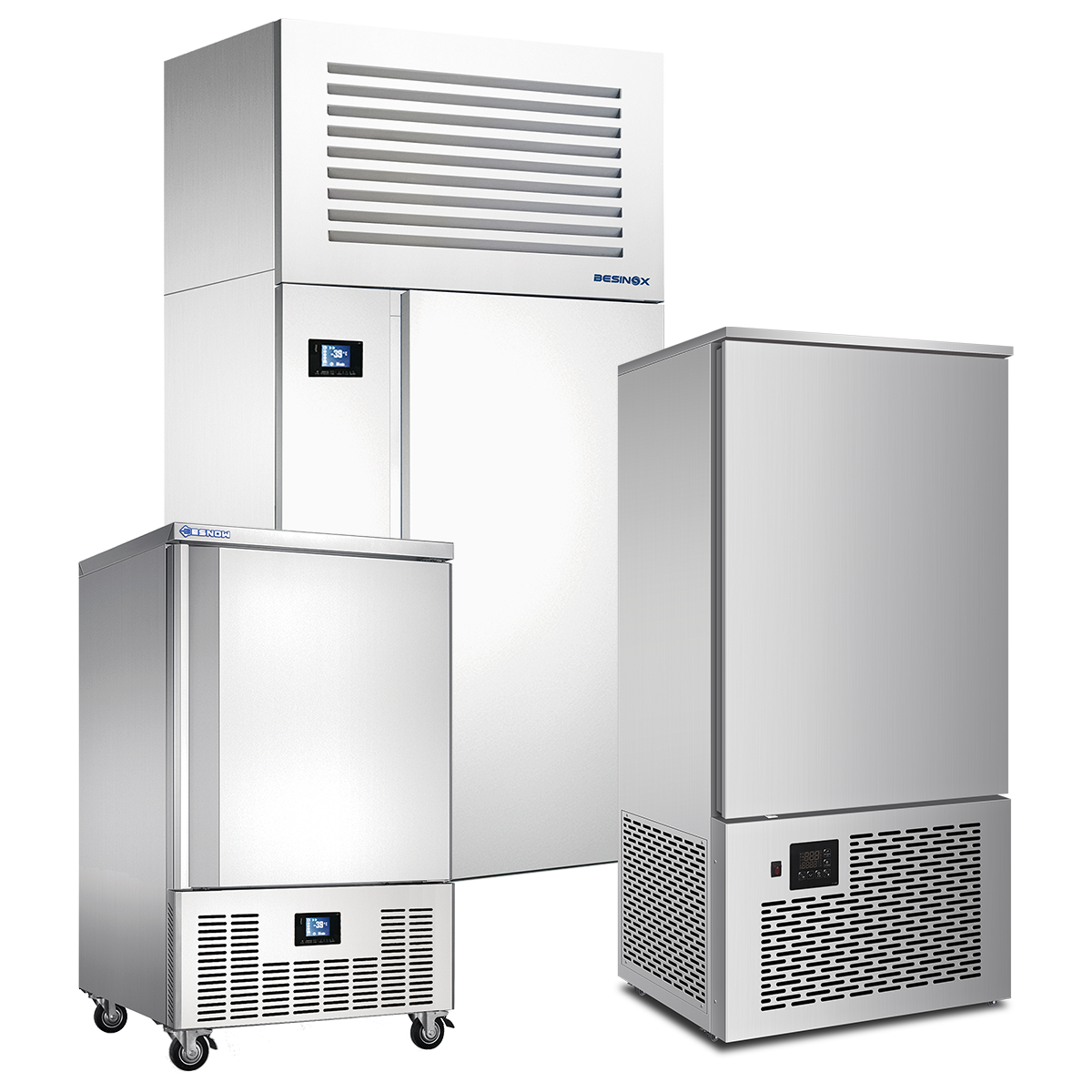
A commercial blast chiller is a controlled cooling chamber designed to remove heat from freshly cooked food more quickly than a standard refrigerator. Depending on the model, product load, container depth, food composition, and starting temperature, the unit may cool food to a refrigerated holding temperature within a commercially useful cycle.
BEU, as a commercial blast chiller manufacturer, can be evaluated according to the same criteria that matter in a HACCP system: temperature performance, probe accuracy, cleanability, capacity, data recording, alarm functions, and service support. The equipment should be selected based on the actual menu and batch size rather than cabinet volume alone.
In a HACCP plan, cooling is commonly identified as a critical control point or a closely monitored control step. A blast chiller supports this point in five ways:
The blast chiller is therefore a control tool, not a stand-alone food safety program. Staff still need to follow personal hygiene, allergen control, cleaning and sanitizing, supplier approval, reheating, holding, and corrective-action procedures.
Before introducing a blast chiller into a food safety process, prepare the equipment, documents, food containers, probes, and staff. A well-designed machine will not produce a compliant result if the load is too deep or the probe is used incorrectly.
Check the following before installation or daily operation:
Do not use a blast chiller as a substitute for portioning. A deep container can still cool slowly even inside a powerful machine. Food thickness, water content, fat content, sugar concentration, protein density, and container material all affect heat transfer.
Record the product name, recipe or batch number, cooking completion time, and responsible employee. Different foods may require different loading arrangements and cooling cycles.
For example, a thick meat sauce, cooked rice, and clear vegetable broth should not automatically use the same container depth. The food safety manager should validate the cooling method for each high-volume product.
Measure and document the final cooking temperature according to the applicable food code and recipe. The cooling clock should begin when cooking ends or when the product is removed from the heat source.
Do not leave the batch on a preparation table for an unrecorded period before placing it in the chiller. That unmeasured time may already consume part of the permitted cooling window.
Transfer the food into clean, sanitized, shallow pans. Spread the product evenly rather than creating a mound in the center. Leave enough space between pans for air to flow around each container.
As a practical starting point, many kitchens use shallow pans around 2 to 3 inches deep for dense foods, but the exact depth must be validated for the recipe and equipment. A smaller batch in a shallow pan usually cools more consistently than the same batch in one deep stockpot.
Pre-cool the chamber if required by the equipment instructions. Load the pans without blocking the evaporator air path, fan outlet, or return-air opening. Close the door promptly and select the validated cooling program.
Do not overload the cabinet simply because the racks physically fit. An overloaded chamber may have insufficient airflow, longer cooling times, and uneven product temperatures.
Place the sanitized probe in the thickest or slowest-cooling portion of the food. For a tray of sauce, this is normally near the center. For meat or a formed product, insert the probe into the geometric center without touching the pan base or sidewall.
Touching metal can produce a misleading reading because the probe may measure the container rather than the food. Sanitize the probe before and after each use to prevent cross-contamination.
At the two-hour point, verify whether the product has reached 70°F or below, where that standard applies. Record the actual temperature, not only “pass” or “okay.” A useful log includes:
| Record | Example |
|---|---|
| Product | Chicken curry, batch 24-031 |
| Cooking completed | 14:10 |
| Blast chiller loaded | 14:18 |
| Two-hour temperature | 68°F at 16:10 |
| Final temperature | 39°F at 18:45 |
| Operator | Initials or electronic user ID |
Continue cooling until the product reaches the final target specified in the HACCP plan, commonly 41°F or below for refrigerated food in the United States. Check the temperature at the core rather than relying only on the display temperature of the cabinet.
Once the product passes, cover it appropriately, apply a label, and move it to refrigerated storage. Avoid stacking warm containers tightly after the blast chilling cycle because trapped heat can raise the product temperature again.
File the cooling log with the batch or production record. If the equipment has electronic data logging, review the data periodically rather than assuming that an automatic cycle always succeeded.
A compliant record should show what was cooled, when the process started, which temperatures were measured, who performed the check, and what action was taken if a limit was missed.
One practical case involved a 120-seat restaurant producing large batches of soup and braised meat for lunch and dinner service. The kitchen originally placed hot food in deep plastic containers and stored it in a walk-in refrigerator. Staff often measured the surface temperature, which created records below 41°F while the center remained substantially warmer.
The kitchen changed three parts of the process: it divided food into shallow stainless-steel pans, started the cooling record immediately after cooking, and used a blast chiller with a core probe. The chef also assigned one employee to verify the two-hour temperature and another to review the final result.
In the chef’s account, the main improvement was not simply shorter cooling time. The team could now identify which products needed a shallower load, which recipes required smaller batches, and which employees needed retraining. The cooling log changed from a handwritten “refrigerated” note to a time-and-temperature record that could be reviewed during an audit.
This case illustrates an important point: blast chilling works best when it changes the entire workflow. Equipment, container depth, probe placement, staff timing, and corrective actions must work together.
Problem: The center of a deep pot cools slowly because heat must travel a greater distance before reaching the surface.
Solution: Divide the product into shallow pans, reduce batch size, and validate the maximum fill depth. Do not assume that a powerful refrigeration system can overcome poor product geometry.
Problem: The surface may be cold while the center remains above the critical limit.
Solution: Insert a sanitized, calibrated probe into the thickest portion. Measure multiple locations during validation to identify the slowest-cooling point.
Problem: Pans are placed against one another or directly in front of the air outlet.
Solution: Follow the BEU loading diagram or equipment manual. Leave space between containers and never cover the evaporator or fan path.
Problem: Staff record the blast chiller start time rather than the time cooking finished.
Solution: Define “cooling start” in the HACCP plan and train employees to record it at the end of cooking or when the product leaves the heat source.
Problem: The chamber may be at 35°F while the food core is still above the required limit.
Solution: Use the core probe and verify the product directly. The air sensor and food sensor measure different locations.
Problem: Excessive product mass increases thermal load and can extend the cooling cycle beyond the validated limit.
Solution: Establish a maximum batch weight and pan count. If the load changes, repeat the validation study.
Problem: A failed temperature check is crossed out or rewritten without an explanation.
Solution: Follow a written corrective-action procedure. Possible actions include dividing the product into smaller pans, extending the cycle, transferring it to another validated cooling method, discarding it when safety cannot be demonstrated, and investigating the cause.
When comparing BEU or another commercial blast chiller manufacturer, request technical information that relates directly to HACCP performance. Marketing claims such as “fast cooling” are less useful than a documented test result showing product type, starting temperature, food mass, pan depth, ambient conditions, and final core temperature.
Thermal performance depends on more than the lowest advertised chamber temperature. Refrigeration capacity, evaporator surface area, fan volume, airflow distribution, product load, and container design all influence the result. A technically suitable BEU blast chiller should be matched to the kitchen’s actual production pattern.
Validation asks whether the process is capable of meeting the required cooling limits under defined conditions. For example, the kitchen may test its largest batch of beef stew using the deepest approved pan and record temperatures at regular intervals.
Verification asks whether employees continue to follow the validated process. This may include reviewing daily cooling logs, calibrating thermometers weekly or according to the site schedule, observing loading practices, and checking that corrective actions are completed.
A basic validation study should include:
Keep the results with the HACCP documentation. If the recipe, batch size, container, equipment, or loading pattern changes, determine whether revalidation is necessary.
A blast chiller supports HACCP by controlling the cooling environment, improving heat transfer, reducing dependence on guesswork, and creating measurable records. The most reliable process combines shallow containers, immediate loading, correct probe placement, calibrated temperature measurement, validated batch sizes, and documented corrective actions.
For a restaurant, bakery, central kitchen, hospital, school, or food manufacturer, the best equipment decision is based on actual production data rather than cabinet size alone. Select a commercial blast chiller manufacturer such as BEU that can explain capacity, airflow, probe accuracy, cleaning requirements, and service support in measurable terms. When the machine and procedure are properly validated, rapid cooling equipment becomes a practical part of the food safety plan rather than just another refrigeration appliance.
No. A blast chiller is one control measure within a HACCP system. The plan must also address biological, chemical, and physical hazards; sanitation; employee hygiene; allergen management; storage; reheating; holding; monitoring; verification; and corrective action.
In the United States, the FDA Food Code 2022 generally requires cooked food to cool from 135°F to 70°F within two hours and to 41°F or below within a total of six hours. Local regulations may differ, so confirm the requirements of the relevant health authority.
There is no single guaranteed time for every product. Cooling speed depends on food mass, starting temperature, recipe density, fat and sugar content, pan depth, airflow, ambient temperature, and equipment capacity. Ask the manufacturer for test conditions and validate the process with a core probe.
Only if the equipment instructions and validated procedure allow it. In most commercial workflows, transferring the food into shallow pans produces more predictable cooling. A deep stockpot can retain heat in the center and may exceed the permitted cooling time.
Yes, in most HACCP applications. The cabinet display normally shows air temperature, while the core probe measures the food. Product temperature is the value needed to verify whether the cooling limit has been achieved.
Follow your HACCP program, local regulations, and the thermometer manufacturer’s instructions. Many operations perform routine calibration checks using an ice-point method and recalibrate after impact, repair, or a failed verification check.
Follow the written corrective-action procedure. First, verify the reading and probe condition. Then notify the responsible food safety manager, document the deviation, determine whether an approved alternative cooling step can safely complete the process, and discard the product if safety cannot be demonstrated. Never silently alter the record.
BEU can be considered when its equipment specifications, capacity, temperature-control functions, probe system, sanitation design, energy requirements, and after-sales support match the facility’s HACCP needs. Request a product data sheet and discuss the actual product load before selecting a model.
To visit Guangzhou BEU Electric Appliance Co., Ltd. (called as BEUEA below) website, you are agreeing the terms and conditions within this policy.
BEUEA respects your privacy and will protect your information remains confidential.
We will not lease, sell, or rent your information to the third party for their independent use under any circumstances.