 11/23 ,2026
A café owner replacing two unreliable display coolers, a supermarket planner fitting out a new aisle, and a distributor building a private-label range all face the same decision: how to source a refrigerator that suits the site, meets local rules, and arrives ready to work. This guide is for buyers comparing options from a Commercial Refrigeration Equipment Manufacturer and explains how to buy commercial glass door refrigerators from China, assess a commercial glass door refrigerator supplier in China, and plan importing commercial glass door refrigerators. Along the way, it clarifies merchandiser refrigerator, reach-in cooler, and glass door display fridge terminology, as well as vapor-compression refrigeration, refrigerant GWP, and temperature pull-down testing. The goal is to turn a quote into a verifiable purchasing plan—not just a low unit price.

BEU is one supplier buyers may evaluate during that process. Regardless of the factory, compare documented performance, construction, certifications, packing, and after-sales support against the same requirements. A refrigerator that looks suitable in a catalog can still be the wrong choice if its voltage, ambient-temperature rating, door configuration, or service parts do not match the destination market.
Commercial Glass Door Refrigerator Basics: What the Specifications Mean
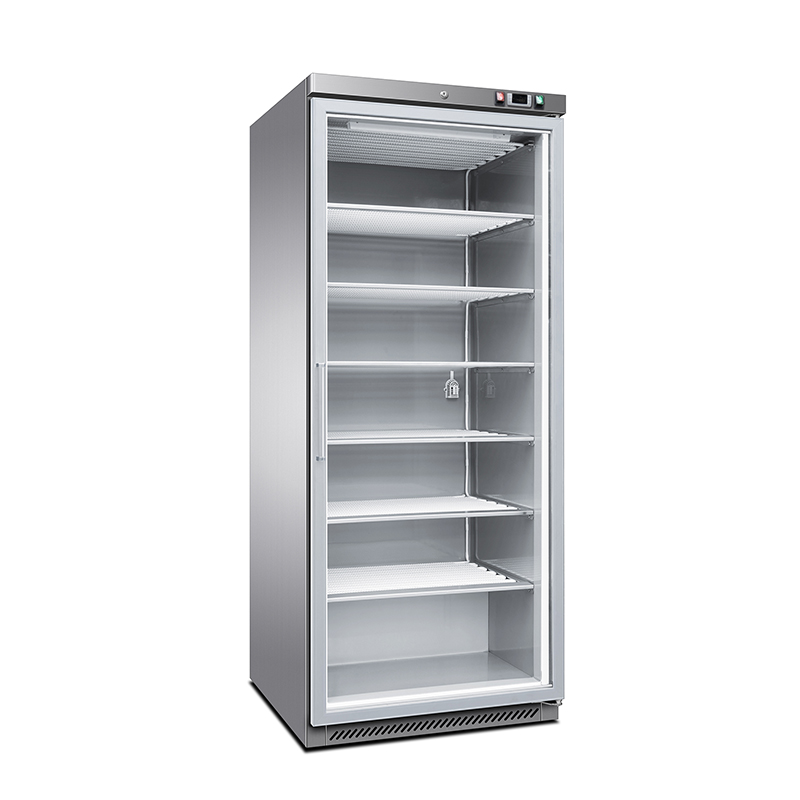
A commercial glass door refrigerator is a refrigerated cabinet designed to display chilled products while allowing customers or staff to see the contents. It is often sold as a merchandiser refrigerator, display cooler, or reach-in cooler. These names overlap, so use the actual cabinet dimensions, operating range, shelving, and intended application—not the product label—to compare models.
How a Commercial Glass Door Refrigerator Cools
Most units use vapor-compression refrigeration. A compressor circulates refrigerant through a condenser, expansion device, and evaporator. The evaporator removes heat from the cabinet; the condenser releases it into the room. Ask whether the unit is ventilated or uses a remote condensing system, where the condenser is located, and how much clearance the installation needs. Restricted airflow around the condenser can increase operating temperature and energy use.
Setpoint and usable temperature are not interchangeable. A controller may be set to a specific value, while actual product temperature varies with loading, door openings, room temperature, airflow, and defrost cycles. For many chilled-food applications, buyers evaluate models around a +2°C to +8°C operating range, but the required range depends on the product and local food-safety rules. Confirm the manufacturer’s test conditions and use a calibrated thermometer or data logger during commissioning.
Commercial Glass Door Refrigerator Features Worth Specifying
- Cabinet size and capacity: Request external dimensions, net volume, shelf dimensions, and usable loading space. Nominal liters alone do not show how many cans, bottles, or packaged items fit.
- Doors and glazing: Specify door count, opening direction, self-closing hinges, double- or triple-pane glass, and whether low-emissivity glazing or anti-condensation heating is fitted. Heated glass may help in humid locations but can affect energy consumption.
- Refrigerant: Record the refrigerant type and charge in grams. Refrigerants differ in environmental impact, safety classification, and legal acceptance. R290 is a lower-GWP hydrocarbon refrigerant, but it is flammable; equipment design, charge limits, installation, and servicing must comply with the rules in the destination country.
- Electrical supply: Confirm voltage, frequency, plug type, rated current, and starting current. A 220–240 V, 50 Hz model is not automatically suitable for a 115 V, 60 Hz market.
- Climate class and ambient conditions: Ask for the declared ambient-temperature and humidity test conditions. A cabinet tested in a mild room may not maintain its range in a hot shop or kitchen.
- Energy use and noise: Compare measured kWh per 24 hours under stated test conditions, not vague claims such as “energy saving.” Check whether the figure includes defrost and whether local energy-label rules require a particular test method.
How to Buy Commercial Glass Door Refrigerators from China
A reliable import starts with a written specification and ends with a receiving inspection. Keep one version-controlled document for the model, options, compliance documents, packaging, and commercial terms so that a sample, purchase order, and delivered shipment can be checked against the same requirements.
Step 1: Define the Commercial Glass Door Refrigerator Application
Write down what the cabinet will store, where it will operate, and who will use it. Note the product temperature requirement, expected room temperature, daily door-opening frequency, available floor space, aisle clearance, and cleaning routine. Measure doorways, elevators, and delivery access—not only the final installation area. For a beverage shop, for example, shelf spacing and bottle capacity may matter more than maximum cabinet volume. For packaged food, temperature uniformity and easy-to-clean surfaces may take priority.
Step 2: Build a Comparable Commercial Glass Door Refrigerator RFQ
Send the same request for quotation to each shortlisted factory. Include cabinet dimensions, door count, shelf layout, temperature range, ambient conditions, voltage and frequency, refrigerant, finish, lighting, caster or foot requirements, branding, and quantity. Ask for a bill of materials or option list, production lead time, sample availability, warranty terms, spare-parts list, carton dimensions, gross weight, and pallet details. Request a drawing and electrical diagram before approving a customized model.
Ask suppliers to identify which figures are guaranteed and which are indicative. A claim such as “low energy consumption” is not comparable until the supplier gives a kWh/24-hour value and the test conditions. If a model is important to your business, request a test report for temperature pull-down, temperature stability, and energy consumption under a stated ambient condition.
Step 3: Verify the Commercial Glass Door Refrigerator Supplier
Check the company’s legal business details, factory address, export experience, product range, and ability to support your destination market. Request current certificates and test reports for the exact model and electrical configuration—not a certificate for a similar cabinet. Verify that the model number, manufacturer name, voltage, refrigerant, and scope shown in the documents match the quotation. Where appropriate, arrange a third-party factory audit or pre-shipment inspection.
Ask how warranty claims are handled across borders. Clarify who pays freight for replacement parts, which components are stocked, what technical documents are supplied, and whether remote troubleshooting is available. A written spare-parts recommendation for the first one or two years can help distributors plan inventory, though the right stock level depends on installed units and local service coverage.
Step 4: Check Commercial Glass Door Refrigerator Compliance
Compliance is determined by the destination country, product design, refrigerant, and sales channel. Depending on the market, requirements may involve electrical safety, electromagnetic compatibility, energy labeling, refrigerant controls, food-contact materials, packaging, and product marking. CE marking may apply to relevant products placed on the European market; US buyers commonly need to confirm applicable electrical safety and energy requirements, while UK requirements can differ from EU requirements. These are examples, not a complete legal checklist.
Before placing an order, ask a local compliance professional, customs broker, or testing body to confirm which rules apply to the exact model. Obtain the declarations, test reports, labels, and manuals in the required language before production. Do not assume a supplier’s general statement that a product is “CE” or “UL” proves that every configuration is approved for your market.
Step 5: Approve the Commercial Glass Door Refrigerator Sample
Inspect a production-representative sample whenever order value or customization justifies it. Check dimensions, door alignment, gasket contact, shelf loading, lighting, controller operation, drainage, finish, packaging, and the nameplate. Run the unit long enough to observe its cooling behavior under documented conditions. Record cabinet air temperature at several positions and, where relevant, product simulant temperature; a single display reading does not establish temperature uniformity.
For a made-to-order run, sign off on a “golden sample” or approved specification sheet. Photograph approved details and list tolerances for dimensions, color, branding, and accessories. This gives both buyer and factory a reference if a later shipment differs from the approved version.
Step 6: Agree on Price, Incoterms, and Payment
Compare the landed cost, not just the factory price. Depending on the Incoterm, the buyer may be responsible for export handling, main freight, insurance, customs clearance, import duties, taxes, port charges, and local delivery. Confirm the named place and the Incoterms edition in the contract. Ask a customs broker to check the likely tariff classification and destination-specific duty before calculating margins; classification depends on the equipment’s design and the importing country’s tariff schedule.
Set payment milestones in the purchase contract and link final payment to agreed inspection or document requirements where commercially feasible. Specify the model, quantity, options, delivery window, packaging, defect process, and remedy for nonconformity. Avoid relying on chat messages where a signed specification and purchase order can state the same terms clearly.
Step 7: Plan Commercial Glass Door Refrigerator Shipping
Choose between full-container and consolidated freight based on shipment volume, timing, and total cost. Ask for packed dimensions and gross weight per unit so a forwarder can estimate container loading and freight accurately. Confirm whether the cabinet ships upright, whether shelves and accessories are packed separately, and what protective materials are used for glass doors and corners. Commercial refrigerators generally should not be tipped or energized immediately after rough handling; follow the manufacturer’s written transport and settling instructions.
Before dispatch, arrange a pre-shipment inspection against the approved specification. Check model and serial labels, voltage, accessories, cosmetic condition, operation, carton marks, and shipping documents. Obtain the commercial invoice, packing list, transport document, certificate or declaration documents required by the destination, and any other paperwork agreed with your broker. Confirm cargo insurance coverage and the process for reporting transit damage.
Step 8: Receive and Commission the Commercial Glass Door Refrigerator
At delivery, photograph the packaging before opening and record visible damage on the carrier’s delivery paperwork. Compare the number of cartons and serial numbers with the packing list. Inspect glass, hinges, cabinet panels, plug, shelves, and controller before signing off the receiving check. Report concealed damage promptly within the carrier’s and seller’s stated claim deadlines.
Install the cabinet on a level surface with the manufacturer’s ventilation clearances. Use the correct electrical circuit and plug configuration, and have qualified personnel handle any work required by local codes. After the specified settling period, start the unit, allow it to stabilize, and log temperatures over a representative operating period with normal loading and door use. Train staff on loading limits, airflow gaps, cleaning, and alarm response. Keep the commissioning record with the invoice and warranty documents.
Commercial Glass Door Refrigerator Cost and Supplier Comparison
For an apples-to-apples comparison, create a scorecard covering cabinet price, freight, duty and taxes, compliance, expected energy use, warranty, spare parts, and local service. A lower purchase price can be offset by higher energy consumption or a long delay for a replacement controller. To estimate annual electricity cost, multiply the verified daily consumption in kWh by 365 and by your electricity rate per kWh. For example, a documented 4 kWh per day would equal about 1,460 kWh per year before adjustments for real-world conditions; the actual result depends on ambient temperature, usage, maintenance, and the test method.
Do not compare energy values from different test methods as though they were directly equivalent. Ask each supplier to state ambient temperature, humidity, setpoint, loading condition, and whether defrost is included. The same rule applies to capacity, noise, and temperature claims: compare measurements made under comparable conditions.
Advanced Commercial Glass Door Refrigerator Buying Tips
Match the Refrigerant to Local Service Capability
Confirm that technicians in your market are trained and legally permitted to service the selected refrigerant. With flammable refrigerants such as R290, safe servicing requires suitable procedures, tools, ventilation, and compliance with local regulations. Request the refrigerant charge, safety instructions, and service manual before ordering. A refrigerant choice is a lifecycle decision, not just a line on the specification sheet.
Reduce Condensation and Protect Product Visibility
Condensation on glass can reduce visibility and frustrate customers, especially in humid shops. Ask whether the unit uses heated glass, an anti-condensation system, or a design tested for particular ambient humidity. Check whether the controller manages that feature and whether it operates continuously or only under certain conditions. Ensure the shop’s air-conditioning and cabinet placement do not direct warm, moist air toward the doors.
Make Serviceability Part of the Purchase
Request a parts diagram, controller model, compressor details, wiring diagram, and cleaning instructions. Agree on part numbers and expected availability for common service items such as door gaskets, fans, sensors, lamps, and controllers. For a chain or distributor, standardizing models can simplify technician training and reduce the number of parts held in stock.
Use a Clear Inspection Plan for Commercial Glass Door Refrigerators
Define inspection criteria before production begins. A practical checklist can cover model identity, dimensions, electrical rating, refrigerant label, surface finish, doors and seals, accessories, cooling operation, packing, and document accuracy. For larger orders, specify the sampling method and acceptable defect criteria with the inspection provider. This turns “quality checked” into a process that both parties can understand.
Choosing a Commercial Glass Door Refrigerator Partner
The right supplier is the one that can document the product, answer technical questions, meet the destination market’s requirements, and support the equipment after delivery. Compare BEU and other qualified manufacturers using the same specification and inspection checklist. Before committing, share your target application, destination country, quantity, preferred dimensions, electrical supply, temperature range, and branding needs so the supplier can quote the correct configuration rather than a superficially similar model.
Buying commercial glass door refrigerators from China is manageable when each stage is documented: define the application, compare a complete RFQ, verify the factory and model, confirm compliance, approve the sample, calculate landed cost, inspect before shipment, and commission the cabinet on arrival. For a commercial glass door refrigerator supplier in China, long-term value depends on documented temperature performance, serviceable parts, and reliable support—not adjectives in a brochure. If you are planning importing commercial glass door refrigerators, speak with BEU about matching the cabinet, refrigerant, electrical configuration, and shipping plan to your market; compare the merchandiser refrigerator, reach-in cooler, and glass door display fridge by measured results, and confirm vapor-compression refrigeration details, refrigerant GWP, and temperature pull-down testing in writing.