 08/25 ,2026
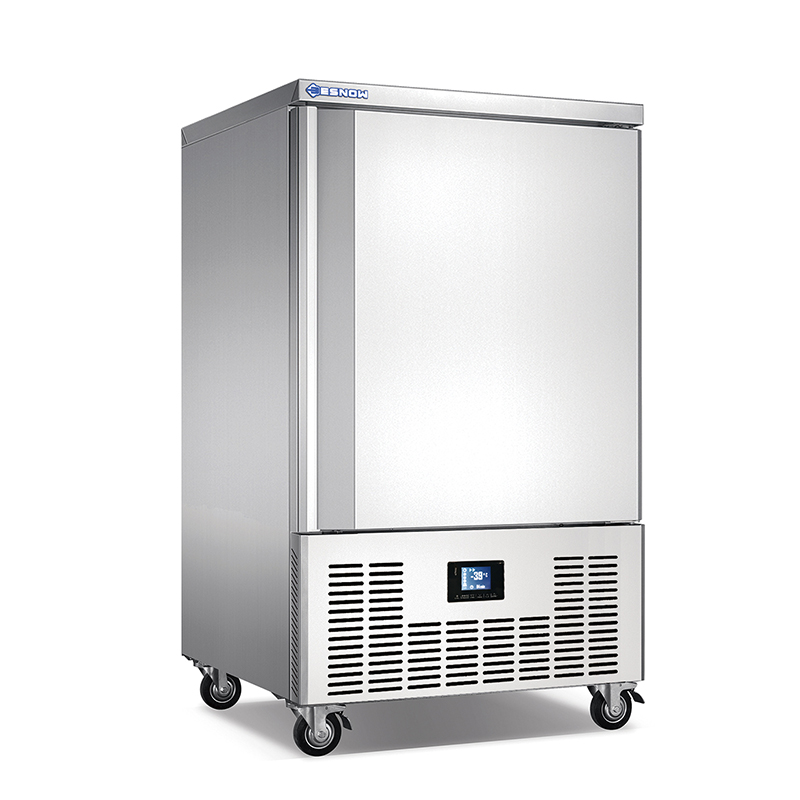
 OEM Commercial Blast Chillers: What Can Buyers Customize? In simple terms, an OEM commercial blast chiller is a professional refrigeration system manufactured to a buyer’s required specifications rather than selected from a fixed, off-the-shelf model. A food manufacturer, hotel, central kitchen, supermarket, or catering company can customize the cabinet dimensions, cooling capacity, temperature range, airflow, controls, materials, electrical configuration, and branding. Working with an experienced commercial blast chiller manufacturer, such as BEU, helps businesses protect food quality, reduce cooling time, improve HACCP control points, and fit refrigeration equipment into a specific production line.

Commercial blast chilling developed from the food industry’s need to cool cooked products quickly and safely. Traditional refrigeration can cool a large volume of hot food slowly. During this period, food may remain in the temperature range where bacteria multiply rapidly.
Blast chilling uses a high-capacity refrigeration system and forced-air circulation to remove heat quickly. Depending on the product, load, container type, and local food-safety rules, a typical HACCP target is to reduce cooked food from approximately +90°C to +3°C within 90 minutes. Blast freezing applications may continue to approximately -18°C, although actual programs must be validated for the product and process.
This technology is now widely used in:
As production methods become more automated, buyers increasingly ask: OEM Commercial Blast Chillers: What Can Buyers Customize? The answer depends on the manufacturer’s engineering capability, production range, refrigeration expertise, and ability to validate the finished system.
A qualified OEM supplier should begin with the buyer’s process rather than simply recommending a cabinet size. The correct specification depends on the food product, batch weight, entry temperature, target temperature, cooling time, loading pattern, ambient conditions, and available utilities.
Capacity is not determined only by cabinet volume. A blast chiller must have sufficient refrigeration capacity to remove the heat from the full batch within the required cycle time.
Buyers can typically customize:
For example, a 100 kg cooked-meal batch entering at +80°C requires a different evaporator, compressor, airflow strategy, and control program than a 30 kg bakery load entering at +25°C. A responsible commercial blast chiller manufacturer should calculate the thermal load instead of selecting equipment only by external dimensions.
OEM engineering is particularly valuable when a facility has limited floor space or a complex production line.
Possible dimensional adjustments include:
The cabinet may also be designed for narrow corridors, cleanroom access, elevator dimensions, or containerized export shipping. Buyers should provide a layout drawing, service clearances, loading route, and ceiling height before the design is finalized.
A blast chiller may be configured for chilling, freezing, or both. Typical customization options include:
The refrigerant should be selected according to environmental regulations, service availability, safety classification, and system design. Buyers should request the refrigerant type, charge information, safety documentation, and efficiency data in the technical offer.
Air distribution is one of the most important technical variables in a blast chiller. Excessive air velocity can dry exposed food, while insufficient circulation can create warm zones and inconsistent cooling.
An OEM design can customize:
Meat, seafood, sauces, bakery products, and ready meals do not respond identically to the same airflow pattern. Product trials or thermal validation are recommended before mass production.
The internal cabinet is commonly manufactured from stainless steel, especially AISI 304. AISI 316L may be considered for highly corrosive environments, salty products, or aggressive cleaning chemicals.
Buyers can specify:
For material verification, the purchaser may request mill certificates or documentation referencing ASTM A240 for stainless-steel plate or relevant EN/DIN material designations. Weld quality, surface finish, and cleanability should be checked through documented inspection rather than assumed from photographs.
Modern OEM Commercial Blast Chillers: What Can Buyers Customize? The answer also includes the control architecture.
Depending on the project, buyers may request:
A core probe is especially useful because cabinet air temperature does not always represent product temperature. For HACCP documentation, the system should record cycle start time, product temperature, operator identity where required, alarm events, and final result.
Electrical customization is essential for international projects. The buyer may specify:
A project specification should identify the applicable electrical and refrigeration requirements. Depending on the market, the design may need to consider IEC 60335-2-89 for commercial refrigerating appliances, EN 378 for refrigeration safety, and local electrical or pressure-equipment regulations. Compliance must be confirmed for the final model and destination country.
Customization is valuable, but not every change is safe or commercially practical. Common errors include:
A larger cabinet does not automatically provide higher throughput. Thermal performance depends on the relationship between compressor capacity, evaporator surface area, fan performance, product load, and cycle control.
Similarly, “fast cooling” should not be judged only by the lowest air temperature. Buyers should request product-core test data under defined conditions, including:
The best way to avoid redesign, delays, and unexpected operating costs is to follow a documented process.
Prepare a process brief that includes:
The manufacturer should calculate the required cooling load. This includes sensible heat, latent heat where freezing occurs, container heat, infiltration, fan heat, and safety margin.
The result should identify:
Before fabrication, request:
This stage is where an experienced commercial blast chiller manufacturer can identify installation conflicts before they become production problems.
A buyer should define acceptance criteria in the purchase contract. Useful checks may include:
Quality documentation may reference ISO 9001 production controls, ASTM A240 material documentation, applicable DIN/EN fabrication requirements, and relevant IEC refrigeration-appliance standards. “100% inspection” should be clearly defined—such as 100% electrical safety testing or 100% cabinet leak inspection—rather than used as an unspecified marketing statement.
After delivery, the system should be leveled, connected, and commissioned by qualified personnel. Validation should be performed using the actual food product, tray arrangement, and production load.
The buyer should receive:
A dependable supplier should also define service expectations, such as a 24-hour response to technical inquiries, spare-parts availability, and escalation procedures.
Consider a central kitchen producing 80 kg batches of cooked rice, sauces, and prepared meals. The facility has a narrow doorway and uses GN 1/1 trays. Its main problems are uneven cooling, limited floor space, and incomplete temperature records.
An appropriate OEM solution could include:
The important point is that the equipment is designed around the production process. Simply purchasing a larger standard cabinet may not solve the airflow or documentation problems.
When evaluating BEU or another OEM supplier, buyers should look beyond the product brochure. Ask for evidence of engineering and production capability, including:
A trustworthy commercial blast chiller manufacturer should explain both the capabilities and the limitations of the proposed design. It should also distinguish between tested performance, estimated performance, and performance that still requires on-site validation.
OEM Commercial Blast Chillers: What Can Buyers Customize? Buyers can usually tailor the capacity, cabinet size, rack system, temperature range, airflow, materials, control system, electrical configuration, refrigerant, hygiene features, and branding.
The most important lessons are:
For businesses comparing OEM Commercial Blast Chillers: What Can Buyers Customize?, the next practical step is to prepare a complete process brief and request a technical proposal from BEU. With the correct engineering data, customization can produce a safer, more efficient, and better-integrated blast chilling system than a generic standard model.
To visit Guangzhou BEU Electric Appliance Co., Ltd. (called as BEUEA below) website, you are agreeing the terms and conditions within this policy.
BEUEA respects your privacy and will protect your information remains confidential.
We will not lease, sell, or rent your information to the third party for their independent use under any circumstances.