 10/08 ,2026
 A commercial blast chiller manufacturer helps restaurants, bakeries, hotels, hospitals, and food factories cool cooked food quickly and safely. The right machine can reduce the time food stays in the bacterial “danger zone,” protect texture, and improve kitchen workflow. Buyers may also search for the best commercial blast chiller manufacturer for restaurants, a custom commercial blast chiller supplier, or an energy-efficient blast chiller manufacturer. These terms describe the same buying problem: how to select equipment that meets food-safety rules, production needs, and long-term operating costs.
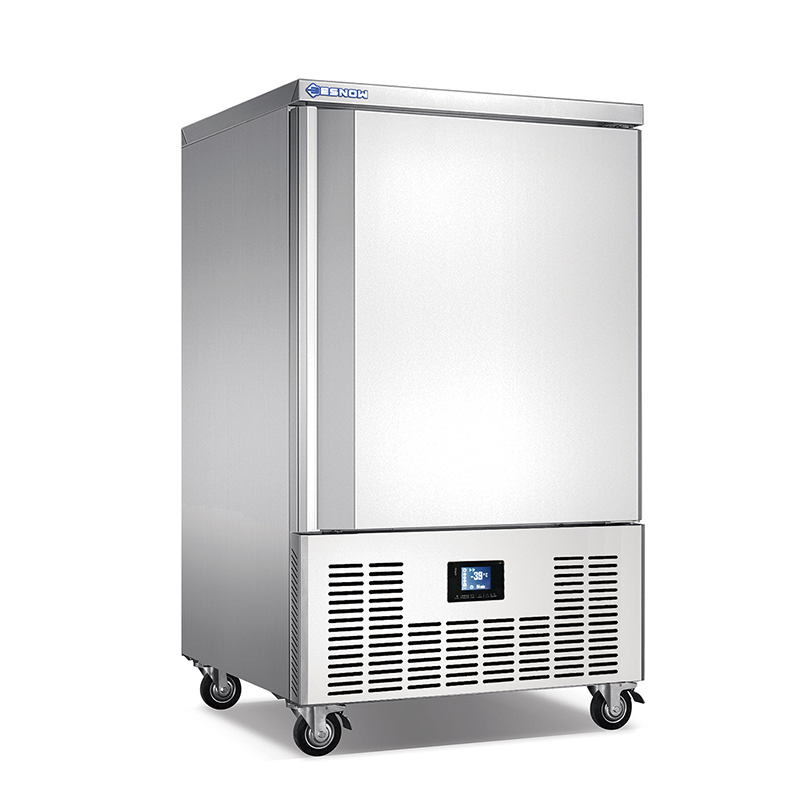
A commercial blast chiller is a professional refrigeration unit designed to reduce the temperature of hot or warm food in a short, controlled period.
Unlike a standard refrigerator, it uses:
The main process is called blast chilling or rapid cooling. It removes heat from food faster than normal cold storage. This helps reduce the time food spends between 41°F and 135°F (5°C and 57°C), a range commonly linked to rapid bacterial growth.
The U.S. Food and Drug Administration (FDA) Food Code recommends cooling cooked food:
The total cooling time should not exceed 6 hours under the FDA Food Code model requirements. Always check local regulations because food laws can differ by country, state, or city.
A busy kitchen may prepare soup, rice, sauces, meat, pastries, and ready-to-eat meals several hours before service. If these foods cool slowly, the center may remain warm even when the surface feels cold.
This creates several practical problems:
A blast chiller addresses these problems by reducing product temperature quickly and evenly. It also supports cook-chill production, a system in which food is cooked, rapidly cooled, stored, and reheated later.
For example, a central kitchen can prepare a large batch of tomato sauce in the morning, chill it under controlled conditions, and distribute it to several restaurants. This improves portion control and reduces repeated cooking.
Commercial blast chillers are used in many industries.
Restaurants use blast chillers for:
Hotels often use them during banquet production. Large quantities of food can be prepared before an event and stored under controlled conditions.
In baking, rapid chilling helps stabilize:
Fast cooling can help reduce moisture loss and preserve the intended structure of delicate products.
Hospitals, nursing homes, and schools often operate under strict food-safety procedures. Blast chillers support batch cooking and controlled storage while reducing the need for last-minute preparation.
Catering companies may prepare food at a production site and transport it to another location. Rapid cooling can improve food handling during transport, but the business must also use suitable insulated containers, temperature monitoring, and documented procedures.
Food manufacturers use larger blast chillers for:
The correct machine depends on product type, tray size, batch weight, packaging, and required cooling time.
Choosing a machine only by cabinet size can lead to poor results. Buyers should compare the complete cooling system.
Capacity is commonly listed as the amount of food the machine can cool per cycle. However, the real result depends on:
A unit rated for 100 kg may not cool every product in the same time. Ask the manufacturer for test conditions and a written performance statement.
Some units operate as blast chillers only. Others combine chilling and freezing functions.
A typical blast chiller may cool food to around 37°F to 41°F (3°C to 5°C), while a blast freezer may reduce food to approximately -0.4°F (-18°C) or lower. The correct target depends on the food and local food code.
Manufacturers should explain the expected cooling time for specific products. A useful test should state:
Avoid relying on claims such as “ultra-fast” without test conditions. A documented result is more useful than an adjective.
Check whether the chiller fits the pans already used in your kitchen. Common formats include:
Incorrect tray spacing can block airflow and increase cooling time.
A core probe measures the temperature inside the food rather than only measuring cabinet air. This is important because dense food may remain warm in the center.
Look for:
Ask which refrigerant the unit uses and whether it meets local regulations. Refrigerants are subject to environmental rules, and availability may affect future maintenance.
The U.S. Environmental Protection Agency regulates refrigerants through programs such as the Significant New Alternatives Policy (SNAP). European buyers should also review current F-gas requirements.
Before ordering, confirm:
A machine that does not match the site’s electrical supply may require costly changes or may not operate correctly.
The manufacturer affects more than the purchase price. It also affects performance, spare parts, service response, and operating life.
A reliable commercial blast chiller manufacturer should provide:
Ask whether the cooling data comes from an independent test or an internal laboratory. Internal testing is not automatically unreliable, but the method should be clear.
Useful features include:
HACCP means Hazard Analysis and Critical Control Points. It is a preventive food-safety system that identifies hazards and controls them at important stages.
The purchase price is only one part of the cost. Also estimate:
For example, if one unit costs less but requires frequent service or has limited spare-parts support, its five-year cost may be higher.
Ask the supplier:
A blast chiller is often connected to daily production. A service plan can be as important as the machine itself.
The lifespan of a blast chiller depends on equipment quality, workload, cleaning, installation, and maintenance. There is no single service-life number that applies to every machine. A unit used for two cycles per day in a clean bakery will face different stress from a unit running continuously in a food factory.
Important factors include the following.
Frequent cycles place more demand on:
Ask the manufacturer for the recommended daily cycle range. Do not select a small machine for a workload that requires constant overloading.
Food should be placed in shallow, evenly spaced pans. Overfilled containers slow heat removal and increase the risk that the core temperature remains above the target.
Do not block the evaporator or airflow path. Follow the loading diagram in the user manual.
Dust and grease on the condenser reduce heat transfer. This can increase compressor operating time and raise energy use.
A practical maintenance plan should include:
The exact interval depends on the kitchen environment. A fryer-heavy kitchen usually needs more frequent cleaning than a clean bakery.
A damaged gasket allows warm air and moisture to enter the cabinet. The compressor then works longer to maintain temperature.
Check that:
High room temperatures make refrigeration harder. Installation near ovens, fryers, steam equipment, or direct sunlight can increase the heat load.
Follow the manufacturer’s required ambient range and clearance. Poor installation may reduce performance and shorten component life.
Voltage fluctuation can damage electronic controls and compressors. Where necessary, use suitable electrical protection recommended by a qualified technician.
Operators should know how to:
Correct use reduces avoidable wear and supports consistent food-safety records.
A blast chiller is not a substitute for good food handling. Use it as part of a complete cooling procedure.
Divide large quantities into shallow pans. Spread thick products into a thinner layer when allowed by the recipe and food-safety plan.
Move cooked food into the blast chiller as soon as practical. Do not leave large containers at room temperature while waiting for staff or storage space.
Place the probe in the thickest or slowest-cooling part of the food. For multiple products, follow the monitoring method in the site’s HACCP plan.
Use the correct setting for:
Do not rely only on the program timer. Confirm the final core temperature with the probe and record the result if required by local rules.
After cooling, cover the food, label it with the product name and date, and move it to suitable cold storage. Keep raw and cooked foods separated.
A large cabinet does not guarantee fast cooling. The refrigeration system, airflow, product depth, and loading pattern also matter.
A tray of thin vegetables cools differently from a deep container of rice or thick sauce. Ask for product-specific testing.
A low-cost unit may have higher energy use, weaker insulation, limited controls, or poor service availability. Compare total ownership cost.
Check doorways, elevators, floor space, drainage, power, and ventilation before ordering.
Grease, food residue, and blocked filters can reduce performance. Select a design that staff can clean without difficult disassembly.
Ask for measurable conditions. “Cools fast” is not enough. A useful claim explains how many kilograms were cooled, from which starting temperature, in which tray, and to what final core temperature.
BEU is a brand to consider when comparing commercial refrigeration and blast-chilling solutions. Buyers should still match the model to their actual workload, local electrical standards, food products, and service requirements.
When contacting BEU or another supplier, prepare the following information:
This information helps the supplier recommend a realistic model rather than a unit based only on cabinet volume.
A normal refrigerator is designed to hold already chilled food. A blast chiller is designed to remove heat from warm food quickly. Placing a large quantity of hot food into a normal refrigerator may raise the cabinet temperature and affect other products.
The FDA Food Code model recommends cooling from 135°F to 70°F within 2 hours, then from 70°F to 41°F within 4 more hours. Local rules may differ, so businesses should follow the requirements of their local authority.
Some models have both chilling and freezing functions. A standard blast chiller may not be designed for deep freezing. Confirm the temperature range and product program before using it as a freezer.
Capacity varies by model and product. The listed capacity should be checked against the food type, tray depth, starting temperature, and required cooling time.
Clean food-contact surfaces after use according to the manufacturer’s instructions and the site’s sanitation plan. Condensers, filters, drains, and gaskets need separate inspection and maintenance.
Service life depends on workload, maintenance, installation, cleaning, and component quality. Ask the supplier for expected service-life information, warranty coverage, and spare-parts support rather than relying on a general industry average.
It may be useful if the restaurant prepares large batches, operates a cook-chill system, produces desserts, or needs to reduce food waste. A capacity calculation can show whether the investment fits the daily workload.
Before selecting a custom commercial blast chiller manufacturer, confirm:
The next step is to measure your typical batch weight, food depth, starting temperature, and daily production schedule. Then compare suitable BEU models, request technical documents, and read the user guide before installation. This process helps you choose an energy-efficient commercial blast chiller manufacturer based on measurable performance rather than advertising language.
To visit Guangzhou BEU Electric Appliance Co., Ltd. (called as BEUEA below) website, you are agreeing the terms and conditions within this policy.
BEUEA respects your privacy and will protect your information remains confidential.
We will not lease, sell, or rent your information to the third party for their independent use under any circumstances.