 08/28 ,2026
 A commercial blast chiller manufacturer helps restaurants, bakeries, hotels, hospitals, and food factories cool cooked food quickly and safely. The right machine can reduce food waste, protect product quality, and support HACCP food-safety controls. Buyers often compare a commercial blast chiller supplier for restaurants, a commercial blast chiller equipment manufacturer, and a custom commercial blast chiller manufacturer before making a decision. This guide explains how blast chilling works, where it is used, what specifications matter, and how to select a reliable supplier such as BEU.

Cooked food cannot remain warm for an unlimited period. Slow cooling gives bacteria more time to multiply, especially when food is stored in large pots, deep containers, or tightly packed trays.
The U.S. Food and Drug Administration (FDA) Food Code requires many cooked, temperature-controlled foods to cool:
The FDA also recommends using shallow pans, smaller portions, and rapid cooling equipment when necessary. You can review the official requirements in the FDA Food Code.
A commercial blast chiller is designed for this task. It removes heat from food much faster than a standard refrigerator. This supports safer storage while helping food retain its texture, color, moisture, and flavor.
For a restaurant, the result is not only better food safety. It can also improve batch production. A kitchen may prepare sauces, soups, cooked meat, pastries, or ready meals in advance and chill them for later service.
A commercial blast chiller rapidly removes heat from cooked food before refrigerated storage or freezing.
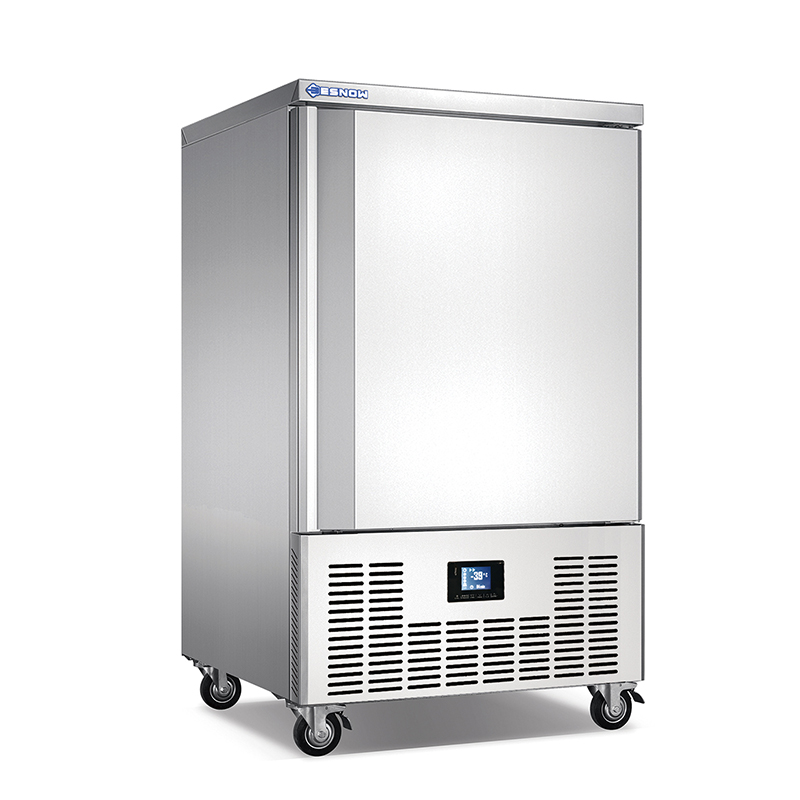
A commercial blast chiller is a professional refrigeration machine that uses high-speed cold air to reduce the temperature of hot or warm food. It is different from a standard cold room or refrigerator because it is built for rapid temperature reduction.
Hot food enters the chamber
Food is placed in trays, pans, racks, or containers. The product should be spread evenly to improve airflow.
Cold air circulates at high speed
The evaporator produces cold air while fans move that air around the chamber. Strong airflow transfers heat from the food surface.
Heat moves from the center to the surface
As the outer layer cools, heat continues moving from the warmer center toward the colder surface. Food thickness has a major effect on cooling time.
The control system monitors temperature
Many machines use a core temperature probe. The probe measures the center of the thickest food item, where cooling is usually slowest.
The cycle ends at the programmed target
The unit may stop automatically when the food reaches a set temperature, such as 3°C or 5°C, depending on the recipe and local food-safety plan.
A standard refrigerator is mainly designed to maintain the temperature of already chilled food. It is not usually designed to cool large amounts of hot food quickly.
A blast chiller is designed to:
The exact cooling time depends on food type, tray depth, starting temperature, load size, airflow, and target temperature. A responsible commercial blast chiller manufacturer should provide tested performance data instead of promising one cooling time for every product.
A deep container of soup or stew can remain warm in the center for hours. A blast chiller uses shallow trays, strong airflow, and controlled refrigeration to remove heat more evenly.
Temperature control is a central part of HACCP. Rapid cooling helps reduce the time food spends between hot holding and refrigerated storage. The machine does not replace safe handling, cleaning, or temperature records, but it can support a stronger control process.
Slow cooling can cause:
Fast chilling can help preserve the original condition of many products. However, each recipe should be tested because foods react differently to cooling.
Without rapid chilling, staff may need to wait for food to cool before storing it. This can delay cleaning, preparation, and the next production cycle. A properly sized unit allows a kitchen to prepare food in planned batches.
Restaurants and catering companies often discard food because it was prepared too early or could not be cooled safely. A blast chiller can extend the usable planning window when combined with correct packaging, labeling, storage temperature, and shelf-life testing.
Commercial blast chillers are used in many food-service and food-production environments.
Restaurants use blast chillers for:
Hotels and banquet kitchens benefit from batch cooking because they may need to serve hundreds of guests at a specific time.
Pastry businesses use blast chillers to cool:
Some models also support shock freezing, which can help protect the structure of delicate products.
Institutional kitchens often prepare meals in large quantities. Rapid chilling supports cook-chill systems, where food is prepared, cooled, stored, and reheated under controlled procedures.
A central kitchen may produce meals for multiple stores or delivery locations. In this setting, temperature consistency, batch records, loading capacity, and cleaning access are important.
Food manufacturers may use blast chillers after cooking, portioning, or packaging. The machine must match the product thickness, packaging style, production volume, and required cooling curve.
Choosing a machine only by external size or listed horsepower can lead to poor results. Compare the following specifications with your actual production needs.
Capacity may be shown in kilograms per cycle, number of trays, or cabinet volume. Ask how the capacity was tested.
A useful calculation is:
Required batch capacity = average batch weight × number of batches per production cycle
Add reasonable working space so trays are not packed too tightly. Overloading reduces airflow and may cause the center of the product to cool too slowly.
Ask the manufacturer for measured results under stated conditions, including:
For example, “cools 20 kg” is incomplete unless the supplier explains whether the product was soup, meat, rice, or pastry.
A core probe provides a more reliable result than measuring only chamber air. The probe should be easy to clean, durable, and placed in the thickest or slowest-cooling part of the food.
Check whether the unit accepts your existing trays, such as:
Compatible trays reduce handling time and prevent the need to buy a completely new storage system.
Ask about the refrigerant type, energy rating, compressor brand, and operating conditions. Energy use depends on:
Do not compare energy figures unless the test conditions are the same.
Food-service equipment should use materials that are easy to clean and resistant to corrosion. Stainless steel interiors are common. Look for:
These details reduce cleaning time and help prevent food residue from accumulating.
A digital controller should allow operators to set a target temperature or cycle time. For larger operations, consider:
Data records can help managers verify that cooling procedures were followed.
The supplier is as important as the machine. Use the following evaluation process.
Record:
This information allows the supplier to recommend a suitable model instead of simply selling the largest cabinet.
The data sheet should include:
If important data is missing, ask for clarification in writing.
A product demonstration is useful, but it should use your real food or a similar product. Test the thickest, heaviest, and most difficult batch.
Measure:
This test gives better evidence than general marketing claims.
Depending on the destination market, equipment may need to meet requirements from organizations such as:
Ask the commercial blast chiller manufacturer for certificates and test reports that apply to your country. Certification requirements vary, so buyers should confirm them with local authorities or an approved inspector.
A machine is only useful if it can be repaired. Ask:
A lower purchase price may become expensive if downtime and parts delays are common.
The purchase price is only one part of the cost. Include:
A suitable commercial blast chiller manufacturer should explain these costs clearly.
Correct operation is essential. Follow the equipment manual and your local food-safety rules.
Monitor the core temperature rather than relying only on the display air temperature. If the cooling target is not reached within the required time, move the food to a safe backup procedure and investigate the cause.
Possible causes include:
When the target temperature is reached:
The blast chiller is not a long-term storage cabinet. Chilled food should be transferred to the correct cold-storage area.
A maintenance program protects cooling performance and food safety.
A dirty condenser restricts heat release. This can increase cycle time, raise energy use, and place more stress on the compressor. The service interval should follow the manual and the kitchen environment.
A large cabinet may still perform poorly if the product is loaded in deep containers. Compare tested batch results, not only liters or tray count.
A thin pastry and a deep pan of stew do not cool at the same speed. Product geometry is often more important than total weight.
A refrigerator may maintain chilled food, but it may not remove heat quickly enough from large hot batches.
Confirm voltage, phase, frequency, breaker size, and plug type before delivery. A mismatch can delay installation or damage equipment.
The machine should be positioned near cooking, portioning, and cold storage areas. Poor placement increases handling time and door openings.
Ask for test conditions and measured core temperatures. A professional supplier should explain how results were obtained.
BEU can be considered by buyers seeking commercial refrigeration and food-processing equipment. When evaluating BEU or another supplier, ask for a model recommendation based on your actual batch size and food type.
Before placing an order, request:
The best supplier is not always the one with the lowest quotation. It is the one that can match the equipment to your process and support the machine after installation.
A blast chiller reduces food to a chilled temperature, often around 0°C to 5°C, depending on the product and local procedure. A blast freezer lowers the product to a frozen state. Some machines combine both functions, but buyers should confirm the actual chilling and freezing performance.
There is no single answer for every food. Cooling time depends on load weight, tray depth, product density, starting temperature, airflow, and target core temperature. Ask for test data using a product similar to yours.
Many commercial blast chillers are designed for hot food, but the operator must follow the manual. Food should be divided into suitable trays, and the total load must remain within the rated capacity.
No. A blast chiller is designed to reduce food temperature quickly. A refrigerator is designed to hold already chilled food. After the cooling cycle, food should be transferred to appropriate cold storage.
Estimate the heaviest batch you need to cool, the number of cycles per day, the available tray size, and your peak production period. Select a model that can handle the required batch without overloading or blocking airflow.
It can help preserve texture, moisture, color, and flavor by reducing the time food remains warm. The final result also depends on recipe design, packaging, hygiene, storage temperature, and reheating practice.
The correct certifications depend on your country and installation site. Common examples include CE, UL, ETL, and NSF-related compliance. Always verify local requirements before purchase.
Follow the manufacturer’s maintenance schedule. Kitchens with flour, grease, dust, or heavy daily use may require more frequent cleaning. A blocked condenser can increase energy use and reduce cooling performance.
Before choosing a commercial blast chiller, confirm that you have:
For the next step, download the user guide, prepare your production data, and ask BEU for a model recommendation based on your actual food products. A trial with your own batch is the most reliable way to confirm whether a commercial blast chiller meets your operation’s needs.
To visit Guangzhou BEU Electric Appliance Co., Ltd. (called as BEUEA below) website, you are agreeing the terms and conditions within this policy.
BEUEA respects your privacy and will protect your information remains confidential.
We will not lease, sell, or rent your information to the third party for their independent use under any circumstances.