 08/05 ,2026
 Meta description: Learn how to choose a commercial blast chiller manufacturer, compare soft chilling and hard chilling, meet food-safety targets, and reduce waste in restaurants, bakeries, catering kitchens, and food factories.
When cooked food must be cooled safely and quickly, choosing the right commercial blast chiller manufacturer affects food quality, kitchen capacity, and compliance. A reliable machine can reduce a product from about 90°C to 3°C in a controlled cycle, helping food businesses manage busy service periods. This guide also explains how to compare a blast chiller supplier for restaurants, select the correct capacity, and understand the difference between soft chilling and hard chilling. For buyers comparing a commercial blast chiller and freezer manufacturer, the key questions are cooling performance, hygiene, energy use, service support, and verified test data.

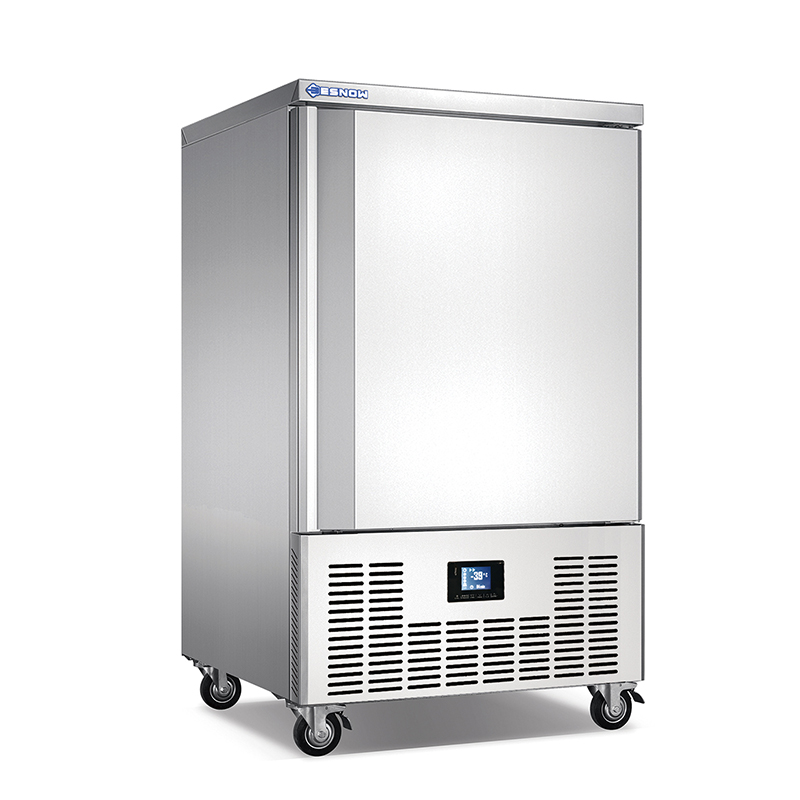
A commercial blast chiller is a refrigeration machine that uses high-speed cold air to remove heat from freshly cooked or processed food. Unlike a standard refrigerator, it is designed to cool hot food in a shorter and more controlled time.
The main parts usually include:
The goal is not simply to make food cold. The goal is to move food through the temperature range where bacteria can grow as quickly as possible.
The U.S. FDA Food Code recommends cooling cooked food from 57°C/135°F to 21°C/70°F within two hours, then from 21°C/70°F to 5°C/41°F or below within the next four hours. A blast chiller helps commercial kitchens achieve this target more consistently than placing hot food directly into a normal refrigerator.
Blast chilling: Rapid cooling of food to a positive cold-storage temperature, commonly around 0°C to 3°C at the food core.
Blast freezing: Rapid cooling below the freezing point, often to approximately -18°C at the food core for frozen storage.
Food-core temperature: The temperature measured at the thickest or coldest part of the food, not the air temperature inside the cabinet.
Pull-down time: The time required for the food core to reach the programmed target temperature.
Air temperature: The temperature of the moving air around the product. It can be much lower than the food-core temperature during a cycle.
“Soft chilling” and “hard chilling” are common commercial refrigeration terms. Their exact set points may differ by product, climate, and machine model, so the manufacturer’s technical manual should always be checked.
Soft chilling normally means cooling food to a positive temperature, such as +3°C. It is used when the product will remain chilled rather than frozen.
Typical applications include:
Soft chilling helps preserve texture because the product is cooled without forming large ice crystals. It is suitable for kitchens that prepare food in batches and serve it over the next one to several days, subject to local food-safety rules and the operator’s validated shelf-life plan.
Hard chilling generally refers to a stronger cooling cycle. In some food-service markets, it means reaching around 0°C to -5°C for products that need an especially cold surface or rapid pull-down. In other markets, “hard chill” is used to describe blast freezing to approximately -18°C.
Because the term is not used in exactly the same way worldwide, buyers should ask the supplier:
For frozen products, the International Institute of Refrigeration and many food-processing standards recognize -18°C as a common storage target. However, the correct target depends on the food type and local regulations.
| Feature | Soft chilling | Hard chilling or blast freezing |
|---|---|---|
| Typical final temperature | About 0°C to +3°C | From below 0°C to about -18°C |
| Main purpose | Short-term chilled storage | Frozen storage or deeper pull-down |
| Common products | Cooked meals, sauces, vegetables | Meat, seafood, frozen meals, ice cream |
| Texture risk | Lower risk of ice crystal damage | Greater need to control ice crystal size |
| Storage condition | Chilled cabinet | Freezer or frozen warehouse |
| Key control point | Food core reaches safe chilled temperature | Food core reaches validated frozen temperature |
Slow cooling gives bacteria more time to multiply. A blast chiller shortens the time food spends in the microbial growth range.
The equipment does not replace food-safety procedures. Staff still need to:
The FDA Food Code is a useful reference for cooling controls, but each business must follow the rules in its own country or region.
Fast cooling helps protect color, flavor, moisture, and texture. For example, a large pot of soup left to cool at room temperature may develop a skin, lose water, or remain warm at the center. Dividing the soup into shallow pans and using a blast chiller creates a more repeatable process.
Waste reduction should be measured with real operating data, such as:
A blast chiller allows a kitchen to prepare food before peak service. This is useful for:
A kitchen that prepares 100 portions in the morning can cool and store them before the lunch period. This reduces pressure on cooking staff and makes production easier to plan.
Rapid cooling can reduce moisture loss and limit the formation of large ice crystals. This is especially important for:
The actual result depends on the food formula, tray depth, loading pattern, fan speed, and packaging. A supplier should provide test conditions instead of using general claims such as “best quality.”
Restaurants use blast chillers to prepare sauces, soups, cooked proteins, desserts, and ready-to-serve components. Hotels may use larger units for banquets and breakfast production.
A machine should be selected based on the number of trays, tray dimensions, and the expected batch weight. A 10-tray unit may suit a medium kitchen, while a central production site may need a 20-, 40-, or 80-tray system.
Pastry products are sensitive to temperature and moisture. Blast chilling can help stabilize:
For delicate products, operators should use a controlled cycle rather than the coldest possible setting. Excessive airflow or incorrect humidity control may damage decoration or dry the surface.
Catering operations often cook in large batches and transport food later. Blast chilling helps separate cooking time from service time.
The process should include:
Hospitals and care homes require strong control over hygiene, allergens, and traceability. Blast chillers are often used in cook-chill systems.
These facilities should consider:
Food factories may use blast chillers for meat, seafood, ready meals, sauces, and processed vegetables. Industrial systems may include conveyor belts, trolley loading, remote refrigeration units, and automated data recording.
At this scale, buyers should request a product trial using their own food, tray type, packaging, and batch size. A test on an empty cabinet cannot show real production performance.
Do not compare machines by the final temperature alone. Ask for the complete test condition:
For example, “90°C to 3°C in 90 minutes” is only useful if the supplier states whether the test used 5 kg or 30 kg of food.
Capacity should match the kitchen’s batch size. A simple planning method is:
Required capacity = average batch weight × number of batches per cycle
Then add operating space for trays and airflow. Overloading reduces cooling performance because cold air cannot circulate around the product.
Example:
This is only a planning estimate. A supplier should confirm the result through a product test.
Common tray formats include:
The internal width, tray spacing, rack height, and door opening must match the kitchen’s existing equipment. A machine may have a high stated capacity but poor practical capacity if the trays are difficult to load.
Look for:
The European Hygienic Engineering & Design Group, known as EHEDG, publishes hygienic design principles for food equipment. These principles emphasize cleanability, drainage, and the reduction of contamination points.
Ask for:
Energy use varies with product load, ambient temperature, cycle duration, and door opening. A supplier should avoid giving one universal energy number without test conditions.
Depending on the destination market, commercial refrigeration equipment may need to meet requirements related to:
Ask the manufacturer for copies of relevant certificates and declarations. Do not rely only on a logo printed on a sales brochure.
A commercial chiller is a production asset. Service quality can affect operating costs more than the initial purchase price.
Ask about:
A reliable blast chiller supplier for restaurants should provide installation instructions, operation training, cleaning guidance, and troubleshooting support.
Write down:
This information makes supplier comparisons more accurate.
Choose a blast chiller if the main requirement is chilled storage. Choose a blast freezer if the business needs frozen storage. A combination blast chiller-freezer may be more flexible, but it can cost more and may require additional electrical power.
Send the supplier a sample product or detailed recipe. The test should measure the food-core temperature, not only the cabinet air.
Request a report showing:
Confirm:
A poorly ventilated condenser room can increase pressure, energy use, and compressor wear.
Operators should know how to:
The best equipment can fail to meet its target if staff overload the cabinet or leave the door open.
A cabinet rated for 40 kg may not cool 40 kg of dense stew in the same time as 40 kg of sliced vegetables. Product density and tray depth matter.
Air can reach the target temperature while the center of the food remains warm. Always confirm the food-core temperature.
Deep pans slow heat transfer. Shallow pans generally provide a shorter cooling path.
Packaging can trap heat and delay cooling. Follow the food manufacturer’s packaging and cooling instructions.
Dust on the condenser restricts heat release. A dirty condenser may increase energy consumption and reduce cooling capacity.
A blast chiller cools food. It does not replace a proper refrigerator or freezer. After the cycle, transfer products to the correct storage equipment.
Temperature probes should be calibrated at a planned interval. A small probe error can create an incorrect food-safety record.
The following resources can support purchasing and HACCP planning:
U.S. FDA Food Code 2022
Cooling requirements and food-safety controls:
https://www.fda.gov/food/fda-food-code/food-code-2022
U.S. Department of Agriculture Food Safety and Inspection Service
Food handling and cooling guidance:
https://www.fsis.usda.gov/food-safety
NSF International
Commercial food equipment and sanitation standards:
https://www.nsf.org/food-beverage
EHEDG
Hygienic design principles for food-processing equipment:
https://www.ehedg.org/
U.S. Environmental Protection Agency
Refrigerant and greenhouse-gas information:
https://www.epa.gov/section608
These sources do not replace local laws or a site-specific HACCP plan. They provide a useful starting point for technical and compliance discussions with a manufacturer.
BEU can be included in a supplier comparison when a buyer needs commercial chilling equipment, product customization, and technical communication in one process. Before placing an order, ask BEU for:
The most useful supplier is not necessarily the one with the lowest listed price. Compare the total operating result, including cooling time, energy use, maintenance, downtime, and product loss.
For chilled food, many systems target approximately 0°C to +3°C at the food core. The correct target depends on the product, local food law, and the company’s validated process.
No. A refrigerator maintains cold storage. A blast chiller is designed to remove heat from hot food quickly. After cooling, food should be transferred to suitable chilled storage.
Blast chilling normally cools food to a positive chilled temperature. Blast freezing reduces the food core below the freezing point, commonly to around -18°C for frozen storage.
Yes, but the soup should be placed in shallow containers with enough space for air circulation. A deep, tightly packed container can keep the center hot for too long.
Compare your actual batch weight, tray size, product density, and required cooling time with the supplier’s test data. Do not rely only on the cabinet’s external dimensions or empty-cabinet capacity.
The time can range from less than one hour to several hours. It depends on food type, load weight, tray depth, starting temperature, airflow, and target core temperature. Request a test using your product.
A blast chiller is not a sterilizer. It reduces the time food remains in a temperature range that supports bacterial growth. Safe cooking, handling, sanitation, cooling, and storage are still required.
Ask for food-core test results, loading conditions, energy data, certifications, warranty terms, spare-parts support, cleaning instructions, installation requirements, and local service availability.
Start by measuring your real production needs, then compare verified food-core cooling data rather than general marketing claims. Check soft chilling and hard chilling settings, tray compatibility, hygiene design, energy use, certifications, and service support. Before installation, read the user guide, validate the cooling process with your own products, and train every operator. If you are comparing a commercial blast chiller and freezer manufacturer, BEU can be one option to include in your technical and product trial review.
To visit Guangzhou BEU Electric Appliance Co., Ltd. (called as BEUEA below) website, you are agreeing the terms and conditions within this policy.
BEUEA respects your privacy and will protect your information remains confidential.
We will not lease, sell, or rent your information to the third party for their independent use under any circumstances.