 09/16 ,2026
 A commercial blast chiller should normally cool the food core to 5°C (41°F) or below before refrigerated storage. For many professional kitchens, the target is 3°C (37°F) within about 90 minutes, depending on the food, container, and local food code. Understanding the correct commercial blast chiller temperature, following blast chilling food safety standards, and choosing the right commercial blast chiller for restaurants can reduce bacterial growth, protect food quality, and improve kitchen workflow.

A commercial blast chiller should usually achieve these targets:
| Cooling stage | Recommended target | Common food safety reference |
|---|---|---|
| First cooling stage | From 57°C to 21°C within 2 hours | FDA Food Code |
| Final cooling stage | From 21°C to 5°C or below within 4 more hours | FDA Food Code |
| Practical blast-chilling target | 3°C to 5°C at the food core | Common commercial practice |
| Frozen food target | -18°C or below for long-term frozen storage | Common frozen storage standard |
The most important measurement is the food’s core temperature, not only the air temperature inside the cabinet.
A chiller may display an air temperature of -5°C, but the center of a deep tray of soup may still be above 10°C. For this reason, professional units use a core probe, also called a food temperature probe, to measure the actual product temperature.
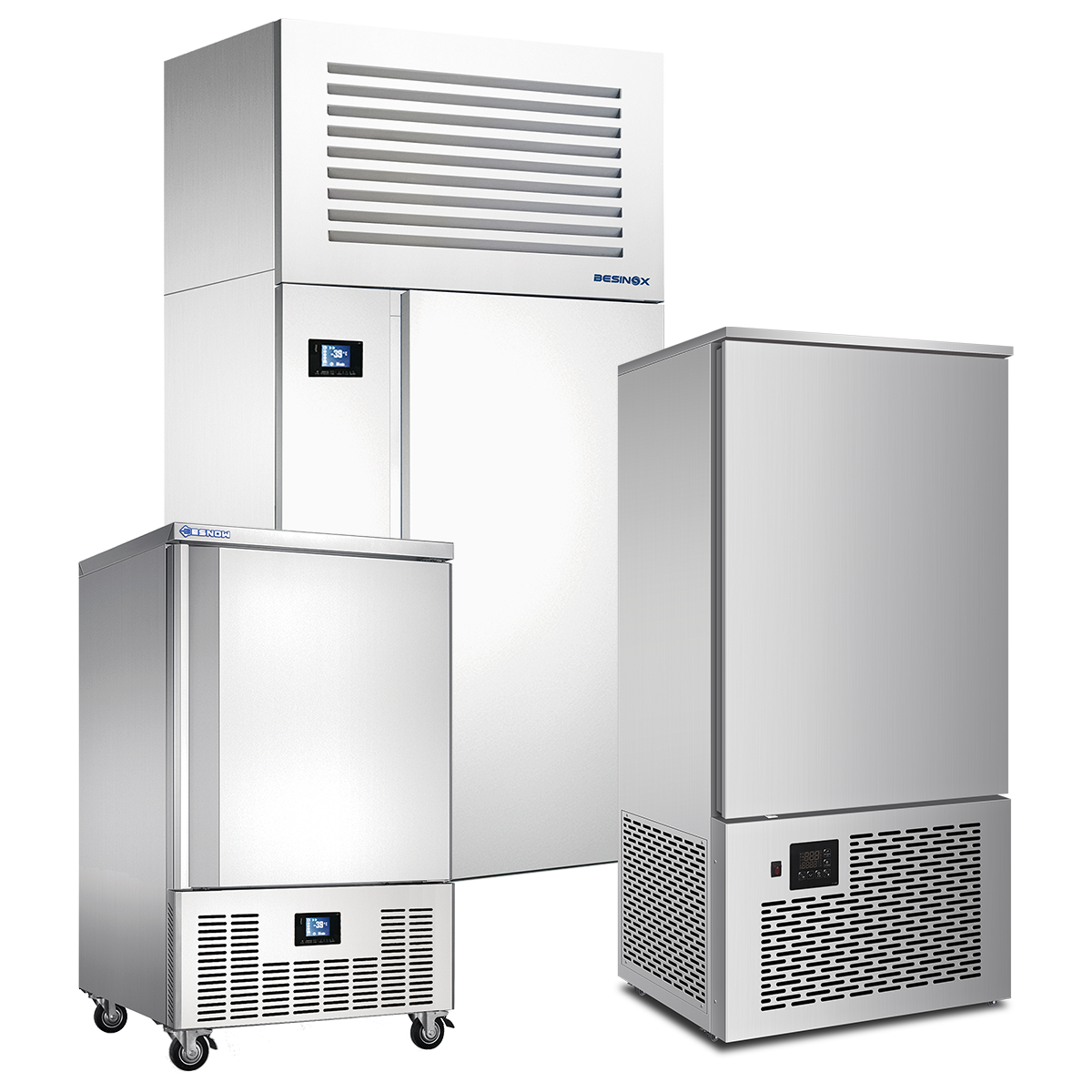
A commercial blast chiller is a refrigeration machine designed to remove heat from cooked or fresh food quickly. It uses cold air moving at high speed across the food surface. This process reduces the time food spends in the temperature range where bacteria can multiply quickly.
The key industry term is rapid cooling. It is different from placing hot food in a normal refrigerator.
A standard refrigerator is designed mainly to keep cold food cold. It may not have enough cooling power to safely cool a large pot of hot food. If hot food is placed inside, the cabinet temperature can rise and affect other products.
A blast chiller is built with:
The goal is to remove heat quickly while limiting moisture loss, texture damage, and bacterial growth.
Bacteria grow quickly when food remains warm for too long. The exact risk depends on the food type, acidity, water activity, storage time, and handling conditions.
The FDA Food Code 2022 requires cooked, temperature-controlled food to cool:
This gives a total maximum cooling time of 6 hours.
Many food businesses set a stricter internal target, such as cooling food to 3°C within 90 minutes. A tighter target creates a safety margin and supports longer refrigerated storage, but it must be validated for the food and equipment.
The United States Department of Agriculture also advises that perishable food should not remain in the “danger zone” for extended periods. In the United States, this range is generally described as 4°C to 60°C (40°F to 140°F).
Local requirements may differ. Restaurants should follow the food code used by their local health authority.
Do not confuse these three temperatures:
The core temperature is normally the most important measurement for food safety records.
Blast chilling uses forced cold air to transfer heat away from food.
The process usually follows these steps:
Large pots and deep containers cool slowly because heat must travel a long distance from the center to the surface.
For faster cooling:
A shallow pan may cool much faster than a deep stockpot because the heat has a shorter path to travel.
The evaporator produces cold air, while the fan moves that air around the food. Strong airflow improves heat transfer.
However, very high airflow is not always ideal. Delicate foods may develop surface drying or skin formation. Good equipment allows operators to select a suitable cycle.
The probe should be placed in the thickest or slowest-cooling part of the food. For liquid foods, the probe must be clean and positioned so it does not touch the pan.
When the core reaches the programmed temperature, the blast chiller can switch to a holding mode.
After rapid cooling, food should be covered, labeled, dated, and moved to a refrigerator or cold room at the required storage temperature.
Blast chilling is not a replacement for proper cold storage. It is the rapid cooling stage before storage.
The correct target depends on the food and the intended use.
Cooked meat and poultry should be cooled rapidly to 5°C or below before refrigerated storage. Large roasts and thick products need special attention because the center may stay warm after the outside becomes cold.
Use:
Liquids can hold heat for a long time. A large pot may remain above safe temperatures even when the surface feels cool.
Recommended methods include:
Cooked rice and grains require careful control because Bacillus cereus spores can survive cooking. If the food is held warm or cooled too slowly, bacteria may multiply and produce toxins.
Blast chill rice and pasta in shallow layers. Record the start time and the final core temperature.
Blanching and cooling vegetables quickly helps protect color, firmness, and nutritional quality. Some vegetables may require a separate chilling cycle to avoid freezing damage.
Custards, mousse, cheesecake fillings, and cream-based desserts benefit from quick cooling. A stable cold temperature helps improve texture and reduces the time that milk and egg ingredients remain warm.
Fresh fish and seafood are sensitive to temperature changes. A blast chiller can reduce product temperature quickly, but operators must also control sanitation, ice quality, packaging, and cross-contamination.
There is no single cooling time for every product. Cooling speed depends on:
A commercial unit may cool a shallow tray of cooked vegetables to 3°C in less than 90 minutes. A deep container of sauce may require much longer.
The safest approach is to create a cooling curve for each major food item:
If a product repeatedly misses the target, change the portion size, pan depth, cycle setting, or equipment capacity.
A blast chiller works best when the kitchen prepares food correctly.
A pan depth of approximately 5 cm to 7.5 cm often cools faster than a 15 cm or 20 cm deep container. The correct depth depends on the food and the manufacturer’s instructions.
Overloading blocks airflow and increases cooling time. Keep space between pans and do not exceed the rated batch weight.
Some machines perform better when the chamber is already cold. Follow the equipment manual because certain units use a specific pre-cooling program.
Every door opening adds warm air and increases the cooling load. Organize the food before starting the cycle.
A dirty probe can transfer contamination between batches. Clean and sanitize it before and after each use.
A probe that reads 3°C when the actual food temperature is 7°C creates a food safety risk. Calibrate thermometers regularly using an approved method, such as an ice-point check at approximately 0°C.
Choosing the right commercial blast chiller manufacturer involves more than comparing the lowest purchase price. The machine must match the kitchen’s batch size, food types, electrical supply, and daily production schedule.
Check the rated batch weight in kilograms, not only the number of trays. A unit may hold ten trays but may not safely cool ten full trays of dense food.
Ask about probe accuracy and calibration support. A difference of 2°C can affect whether a batch passes the internal food safety limit.
Request test results for real products, including:
A claim such as “fast cooling” is less useful than a test showing that a 20 kg batch cooled from 57°C to 5°C in a documented period.
Modern machines may record:
Digital records can make inspections and internal audits easier.
Look for:
The design should reduce places where food residue and water can collect.
A blast chiller is a critical production machine. Ask about:
Check the electrical rating and energy consumption. A larger unit may shorten production time but use more power. Compare total operating cost over several years rather than only the purchase price.
Blast chillers are used in many professional food operations.
They allow chefs to prepare sauces, stocks, cooked meats, desserts, and side dishes before service. This supports batch cooking and reduces pressure during busy periods.
Caterers often prepare food in a central kitchen and transport it later. Rapid chilling helps maintain product quality during storage and delivery.
These facilities require consistent temperature control and documented food safety procedures. Blast chilling supports cook-chill systems.
Large institutional kitchens can prepare meals in batches and distribute them according to a planned schedule.
Blast chillers help stabilize cream products, fillings, mousse, chocolate items, and shaped dough products.
Manufacturers use rapid cooling to improve production consistency and prepare products for packing, cold storage, or further processing.
Ready-meal companies use blast chilling to cool food quickly after cooking and before sealing, labeling, and distribution.
Correct blast chilling provides measurable operational benefits.
Cooling food to 5°C or below within the required time limits reduces the period available for bacterial growth.
A stable, documented cooling process can support a validated shelf-life plan. Shelf life must be confirmed by the food business and may require microbiological testing.
Rapid cooling can reduce:
The result depends on recipe design and the selected cooling cycle.
If a business safely stores more prepared food, it can reduce repeated cooking and discard fewer unused portions.
Restaurants can prepare food during quieter hours and focus on service during peak periods.
Temperature records, probe readings, and cycle reports provide evidence that the process is controlled.
The cabinet may be cold while the center of the food remains warm. Always check the food core.
Deep containers slow heat transfer and can cause the center to miss the required time limit.
Too much food reduces airflow and increases the load on the refrigeration system.
Uncovered food may dry out and can become exposed to contamination. Use suitable covers after the initial cooling stage, according to the equipment and food safety procedure.
A probe can carry bacteria from raw poultry to cooked food if it is not cleaned and sanitized.
A crowded refrigerator may not remove heat fast enough. It can also raise the temperature of nearby food.
A new recipe may have a different density, portion size, or fat content. Test the cooling time instead of assuming the old setting will work.
Use this basic procedure as a starting point. Adapt it to local regulations and the manufacturer’s manual.
If a batch fails to reach the target, do not simply record a passing result. Isolate the food, follow the corrective action in the HACCP plan, and investigate the cause.
The following sources are useful when creating a blast-chilling procedure:
FDA Food Code 2022 — Provides the 57°C-to-21°C and 21°C-to-5°C cooling requirements for temperature-controlled foods:
https://www.fda.gov/food/fda-food-code/food-code-2022
USDA Food Safety and Inspection Service — Offers guidance on safe food temperatures, refrigeration, and handling:
https://www.fsis.usda.gov/food-safety
UK Food Standards Agency — Provides food safety guidance for cooling, storage, and catering operations:
https://www.food.gov.uk/
Codex Alimentarius — Provides international principles for food hygiene and HACCP-based food control systems:
https://www.fao.org/fao-who-codexalimentarius/
Always check the rules of the country, state, or city where the kitchen operates. A local health authority may require a different temperature, recording method, or cooling validation process.
It may be able to reach 0°C or lower in the cabinet, but this is not always the correct food target. For most chilled foods, the important target is a core temperature of 5°C or below. Setting the product too close to freezing can damage vegetables, sauces, dairy products, and delicate desserts.
A final core temperature of 10°C is normally too high for standard refrigerated storage. Food should generally be cooled to 5°C or below, unless a specific local regulation or validated process allows another limit.
No. A blast chiller normally cools food for refrigerated storage. A blast freezer reduces the food core to a frozen state, often around -18°C or below for long-term frozen storage.
Test it with a calibrated probe and a normal full batch. Record the starting temperature, intermediate temperatures, final temperature, and cooling time. Compare the result with the equipment specification and your HACCP limits.
Usually, no. A large stockpot can block airflow and may exceed the machine’s rated load. Divide the stock into shallow pans unless the manufacturer specifically approves stockpot use.
Follow the manufacturer’s instructions and your food safety plan. Many kitchens check probes regularly and calibrate them at a scheduled interval, as well as after damage or a failed temperature check.
Follow your documented corrective action. This may include checking the batch size, moving the food to shallow pans, verifying probe accuracy, reviewing the cycle, and deciding whether the food can be safely used. When safety cannot be confirmed, discard the product.
The correct answer to “What temperature should a commercial blast chiller reach?” is usually 5°C or below at the food core, with many kitchens targeting 3°C for additional control. The food must also pass the required time limits, such as cooling from 57°C to 21°C within 2 hours and then to 5°C within the next 4 hours.
Before buying equipment, calculate your daily batch size, food depth, production schedule, storage capacity, and local legal requirements. Then compare cooling test data, probe accuracy, cleaning design, data logging, energy use, and after-sales support.
For more guidance, read the user manual, review the FDA or local food code, and ask BEU about suitable commercial blast chilling equipment for your kitchen. A properly selected commercial blast chiller temperature system can support safer production, more consistent quality, and better control over the entire food preparation process.

To visit Guangzhou BEU Electric Appliance Co., Ltd. (called as BEUEA below) website, you are agreeing the terms and conditions within this policy.
BEUEA respects your privacy and will protect your information remains confidential.
We will not lease, sell, or rent your information to the third party for their independent use under any circumstances.