 09/01 ,2026
 Food can be fully cooked, visually attractive, and safe to serve, yet still lose its commercial value within hours because it cools too slowly. Slow cooling allows residual heat to remain in the product, encouraging moisture migration, ice crystal formation during later freezing, protein denaturation, starch retrogradation, and microbial growth. These changes can turn crisp vegetables soft, make meat dry, cause sauces to separate, and leave bakery fillings watery. Understanding Why Blast Chilling Helps Preserve Food Texture and Quality is therefore essential for restaurants, central kitchens, caterers, food manufacturers, and retailers that depend on consistent quality and reliable shelf life.
For companies evaluating a commercial blast chiller manufacturer, BEU provides professional cold-chain equipment designed to accelerate heat removal while protecting the product’s sensory and structural characteristics.
The central problem is not simply that warm food takes time to cool. It is that the cooling curve directly affects the food matrix.
A freshly cooked product contains stored thermal energy. If it remains in a conventional refrigerator or at room temperature, the center may stay warm while the surface appears cool. This creates uneven cooling and increases the time that food spends in the microbial “danger zone.”
Under the FDA Food Code 2022, cooked potentially hazardous food should generally be cooled:
These limits are practical food-safety benchmarks, but they also matter for texture and quality. The longer food remains hot, the greater the risk of:
This is the technical foundation of Why Blast Chilling Helps Preserve Food Texture and Quality: rapid, controlled cooling reduces the time available for these unwanted reactions.
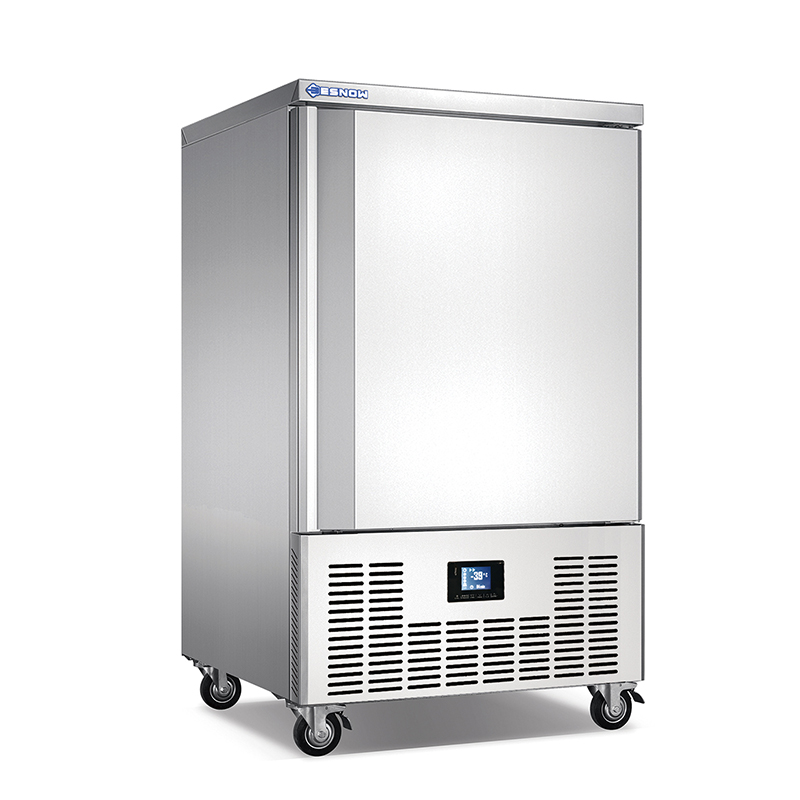
A blast chiller uses high-velocity, low-temperature air to remove heat from food more quickly than a standard walk-in refrigerator. Powerful airflow improves convective heat transfer across trays, pans, and containers.
For products such as roasted vegetables, poultry, seafood, and prepared meals, faster cooling helps stop the cooking process at the intended endpoint. This supports:
The exact cooling time depends on portion depth, product density, container material, loading pattern, and probe placement. A qualified operator should validate the process using a calibrated core-temperature probe rather than relying only on cabinet temperature.
When food is cooled before freezing, it passes through the maximum ice-crystal formation zone more efficiently. In a conventional freezer, slow freezing can create large ice crystals that rupture cell membranes.
After thawing, this damage often appears as:
Blast chilling is not identical to blast freezing, but it is an important part of a controlled chilling and freezing sequence. Pre-chilling food rapidly can reduce the thermal load on the freezer and improve the consistency of the final frozen product.
Texture is closely linked to water distribution. Rapid chilling helps limit uncontrolled evaporation and internal moisture migration.
This is particularly important for:
A stable cooling profile reduces condensation inside packaging and helps preserve the intended mouthfeel. For commercial kitchens, this can mean fewer customer complaints about dry chicken, watery sauces, or limp vegetables.
The cooling performance of a blast chiller depends on more than its advertised air temperature. Product load, airflow distribution, humidity, tray spacing, and core temperature all influence the result.
| Variable | Why it matters | Recommended control |
|---|---|---|
| Product depth | Thick food cools more slowly at the center | Use shallow pans where appropriate |
| Air velocity | Improves convective heat transfer | Avoid blocked evaporator airflow |
| Loading density | Overloading creates warm zones | Follow the manufacturer’s rated capacity |
| Probe location | Surface readings can be misleading | Measure the coldest or thickest point |
| Door opening frequency | Introduces warm, humid air | Minimize unnecessary openings |
| Container material | Affects heat conduction | Use suitable stainless-steel or food-grade pans |
| Cleaning condition | Frost and debris reduce efficiency | Maintain evaporator and condenser surfaces |
BEU’s equipment selection process should consider the product category, batch size, cooling target, kitchen workflow, and available electrical capacity. A properly specified unit is more valuable than a nominally powerful machine that is overloaded or poorly integrated into production.
We recommend that operators establish a documented Standard Operating Procedure (SOP):
This process creates traceability and helps identify whether a problem comes from equipment capacity, product formulation, loading practice, or operator handling.
The value of rapid chilling varies by product, but the quality benefits are widely applicable.
For restaurants, blast chilling supports mise en place and batch production. Chefs can prepare stocks, sauces, braised meats, desserts, and side dishes in advance while maintaining better consistency during service.
It also improves portion control. Once food is chilled rapidly, it can be safely stored, portioned, reheated, and served with more predictable results.
Central production facilities face a greater risk from large batch sizes. A five-liter pan and a fifty-liter batch do not cool at the same rate, even if the recipe is identical.
Blast chilling helps central kitchens:
Manufacturers must consider yield, specification compliance, and customer acceptance. Texture failures can lead to rework, downgraded products, chargebacks, and lost contracts.
Rapid chilling is particularly important for ready meals, deli products, sauces, soups, bakery fillings, and processed proteins. It can help maintain product specifications for color, viscosity, firmness, and portion appearance.
The benefits of a blast chiller are not limited to food safety. They directly influence operating costs and revenue.
Food that loses texture may not be technically unsafe, but it can still be unsellable. A product with excessive purge, poor appearance, or inconsistent firmness may be rejected by quality control or returned by customers.
Reducing these failures can improve:
A controlled cooling process provides a repeatable production schedule. This is important when business models change from made-to-order cooking to batch production, delivery, retail packaging, or multi-site distribution.
When demand increases, relying on domestic refrigerators or improvised cooling methods can create a serious bottleneck. A commercial blast chiller manufacturer such as BEU can help businesses match equipment capacity with actual throughput.
Food businesses increasingly need documented evidence of temperature control. A monitoring system with data logging, calibrated sensors, and alarm functions can support HACCP verification and internal audits.
Food-safety management systems may be structured around ISO 22000, while facility hygiene procedures should also align with applicable local regulations and the FDA Food Code where relevant. For sensory assessment, businesses can use trained panels and reference ISO 8586 for the selection and training of sensory assessors. These standards do not replace product-specific validation, but they strengthen the credibility of the quality program.
A business should not judge blast-chilling performance by cabinet display temperature alone. The correct question is whether the food core reaches the target within the required time while maintaining acceptable sensory quality.
Maintain a test record containing:
For critical products, compare chilled samples with freshly prepared controls. Evaluate:
A useful internal target may be 100% completion of critical temperature records, with a documented corrective action whenever a batch misses the validated cooling limit. Businesses can also set a response target, such as investigating deviations within 24 hours.
These numbers are operational controls, not universal guarantees. Product geometry and formulation must always be tested under real production conditions.
Ignoring cooling performance can create both immediate and long-term risks.
Slow cooling increases the opportunity for pathogen growth, especially in dense foods such as rice, soups, gravies, poultry, and cooked meats. Temperature abuse may not be visible, which makes it more dangerous than obvious spoilage.
Even when microbial growth is not detected, slow cooling can cause irreversible quality loss. Reheating may not restore the original texture once moisture has migrated or cellular structures have broken down.
Poor cooling can result in:
A small kitchen may manage with manual cooling during low-volume production. However, when order volume, delivery distance, or product range increases, the same method may no longer be reliable.
This is why selecting a commercial blast chiller manufacturer early can be a strategic decision. The right equipment supports future changes in menu design, packaging, production scale, and distribution.
When comparing BEU with other suppliers, assess more than the listed temperature range.
Ask the supplier for performance data under defined test conditions. Confirm whether the quoted capacity refers to the total cabinet volume or the actual product load. Also verify whether the equipment can accommodate your tray dimensions and workflow.
Why Blast Chilling Helps Preserve Food Texture and Quality comes down to controlled heat removal. By rapidly lowering the core temperature, blast chilling limits overcooking, moisture migration, microbial risk, and damaging ice-crystal growth. The result is more consistent texture, better appearance, improved shelf-life control, and stronger production efficiency.
For restaurants, central kitchens, caterers, and food manufacturers, this is not simply a refrigeration upgrade. It is a process-control investment that supports HACCP verification, ISO 22000-based food-safety systems, product standardization, and business growth.
If your current cooling process depends on overcrowded refrigerators, shallow manual cooling, or unverified temperature estimates, now is the time to review your risk. Contact BEU to evaluate product load, cooling targets, workflow, and equipment configuration before quality failures become a larger operational cost.
To visit Guangzhou BEU Electric Appliance Co., Ltd. (called as BEUEA below) website, you are agreeing the terms and conditions within this policy.
BEUEA respects your privacy and will protect your information remains confidential.
We will not lease, sell, or rent your information to the third party for their independent use under any circumstances.