 10/07 ,2026
 When a blast chiller fails to reduce food temperature at the expected speed, the problem is more serious than a minor refrigeration delay. Why Is My Blast Chiller Not Cooling Fast Enough? In most commercial kitchens, the answer involves a combination of product loading, airflow restriction, condenser fouling, refrigerant-system performance, probe placement, or incorrect operating settings. If cooked food remains too long in the microbiological danger zone, bacteria can multiply rapidly, shelf life can decline, and the business may face rejected batches, food-safety violations, customer complaints, or costly equipment downtime. We recommend treating slow cooling as a food-safety and operational emergency—not simply as a performance inconvenience.
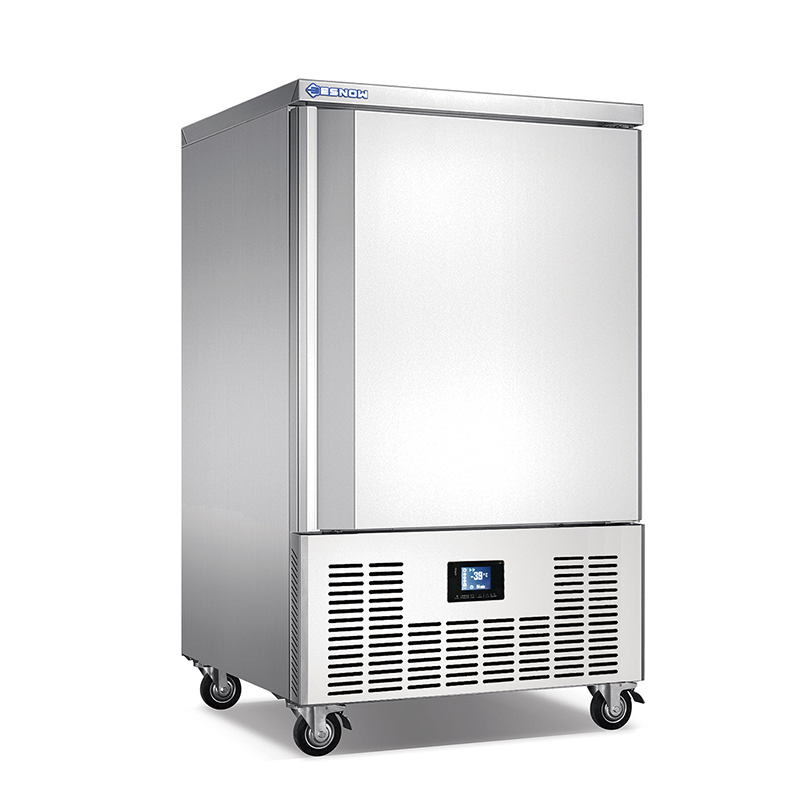
A blast chiller is designed to remove heat quickly from cooked food by circulating low-temperature air at high velocity. Unlike a standard refrigerator, it uses forced-air convection, a refrigeration system with higher capacity, and control logic designed for rapid pull-down.
For many food-safety programs, the critical benchmark is based on the FDA Food Code cooling requirement:
Local regulations may differ, so operators should verify requirements with their health authority and HACCP plan. For equipment performance, buyers and quality teams may also refer to relevant commercial refrigeration and testing frameworks, including EN 17032 for blast chillers and freezers where applicable, along with manufacturer test conditions.
The actual cooling time depends on:
A reputable commercial blast chiller manufacturer should publish capacity, test conditions, pull-down performance, ambient-temperature limits, and recommended loading methods rather than presenting cooling speed without context.
Overloading is one of the most common causes of slow blast chilling. When too many trays are inserted, the evaporator cannot remove heat from every product container efficiently. Dense loading also blocks the air path, creating warm zones inside the cabinet.
Check whether:
A blast chiller rated for 40 kg under specified test conditions may not achieve the same result with 40 kg of dense soup in deep containers. Product thickness and surface area are often more important than total weight.
Corrective action: Divide food into shallow pans, normally around 50–65 mm deep where suitable, leave clearance between trays, and follow the loading diagram supplied by BEU or the equipment installer.
Heat must travel from the center of the food to the surface before the refrigeration system can remove it. A deep container of rice, stew, sauce, or cooked meat can cool much more slowly than several shallow containers with the same total mass.
This is a heat-transfer problem, not only a refrigeration problem. Stainless-steel pans generally transfer heat more effectively than thick plastic containers, while tightly covered pans can restrict heat release during the initial cooling stage.
We should never rely on the cabinet’s air temperature alone. The core temperature of the food must be measured with a calibrated penetration probe.
The condenser rejects heat from the refrigeration circuit. When dust, grease, flour, or lint covers the condenser coil, the high-side pressure can rise and the compressor may operate inefficiently or cycle on a safety control.
Look for:
For many commercial kitchens, condenser cleaning should be part of a documented preventive-maintenance schedule. Frequency depends on the environment; a bakery or frying line may require more frequent cleaning than a low-grease preparation area.
Important: Disconnect electrical power before cleaning accessible components, and use a qualified refrigeration technician for sealed-system work.
A blast chiller depends on high air volume and consistent air distribution. If an evaporator fan is slow, obstructed, noisy, or not operating, cooling time can increase significantly even when the compressor appears to be running.
Possible causes include:
If one section of the cabinet is cold while another remains warm, uneven airflow is a strong possibility. We should avoid bypassing fan guards or electrical controls. A technician should verify fan current, rotation, voltage, and control signals.
Ice on the evaporator acts as an insulating layer and reduces heat transfer. It may result from:
Do not remove ice with knives or sharp tools. This can puncture the evaporator coil and create a major refrigerant leak. Use the manufacturer’s defrost procedure and request service if the ice returns quickly.
A compressed, torn, or incorrectly seated gasket allows warm, humid air into the cabinet. Moisture can freeze on the evaporator, while the refrigeration system works continuously to overcome heat infiltration.
Perform a simple paper test:
If the paper slides out easily in multiple areas, inspect the gasket, hinge alignment, latch, and cabinet frame. Door sealing should be checked as part of routine maintenance.
If loading, airflow, cleanliness, and door sealing are correct, the refrigeration circuit may require professional diagnosis. Potential faults include:
Warning signs include unusually long run times, abnormal pressure readings, overheating, repeated high-pressure trips, or an evaporator that is cold only in one small area.
Refrigerant charging is not a DIY task. A qualified technician should use calibrated gauges, leak-detection equipment, recovery equipment, and the refrigerant specified on the nameplate. The technician should also document the repair rather than simply adding refrigerant without identifying the leak.
A defective probe can cause the controller to end a cycle too early—or display a temperature that does not represent the coldest or warmest food.
Common probe errors include:
We recommend comparing the controller reading with a calibrated reference thermometer. Many food operations verify thermometer accuracy at defined intervals, often using an ice-point check near 0°C and documenting deviations according to their HACCP procedure.
When we investigate slow cooling, we use a structured process rather than immediately assuming a refrigerant failure.
Record:
Confirm that the unit is in blast-chilling mode rather than storage, holding, soft-chill, or defrost mode. Verify the target temperature, time cycle, probe mode, and alarm settings.
Leave space between containers and confirm that no tray blocks the evaporator outlet or return air path. Never exceed the rated load shown in the BEU technical documentation.
Check the condenser, gasket, fan noise, ice formation, drain, and ventilation clearance. Do not remove electrical covers unless you are authorized and trained to do so.
If the problem continues, provide the service team with:
This information can reduce diagnostic time and help a commercial blast chiller manufacturer or service partner respond more effectively.
| Symptom | Likely cause | Recommended action |
|---|---|---|
| Entire batch cools slowly | Overload or excessive product depth | Reduce batch size and use shallow pans |
| Top trays cool, lower trays remain warm | Poor airflow or tray spacing | Reconfigure loading and inspect fans |
| Cabinet is warm and compressor runs continuously | Dirty condenser, high ambient temperature, or sealed-system fault | Clean condenser and call a technician |
| Evaporator is covered with ice | Door leak, defrost fault, or humidity infiltration | Defrost safely and inspect gasket/control system |
| Temperature display drops quickly but food remains warm | Probe misplacement or sensor fault | Verify core temperature with a calibrated probe |
| Unit trips on high pressure | Condenser blockage or inadequate ventilation | Isolate safely and arrange professional service |
| Cooling performance changes by season | Ambient-temperature limitation | Review installation conditions and equipment specification |
Slow blast chilling affects more than one batch. It can disrupt the entire production schedule, especially in central kitchens, catering operations, hospitals, hotels, bakeries, and ready-meal factories.
The business impact may include:
For example, if a kitchen loses only 30 minutes per batch and runs 8 batches per day, it loses approximately 4 production hours daily. Over 26 operating days, that equals about 104 hours per month. The financial impact can exceed the cost of a timely service visit, particularly when labor, refrigeration energy, and product value are included.
The FDA cooling benchmark also demonstrates why time matters. A product that remains above 21°C beyond the first 2-hour stage may require corrective action under the site’s food-safety plan. Operators should not “reset” records or estimate temperatures after the fact.
Consider a representative prepared-food kitchen cooling a 30 kg batch of stew.
The center of the product cools slowly, even though the cabinet display shows a low air temperature.
The corrected approach improves exposed surface area and air circulation. The exact cooling time still depends on product formulation and equipment capacity, but this method gives the refrigeration system a realistic opportunity to meet the intended performance. This is why BEU installation guidance, loading diagrams, and documented commissioning tests are important.
For formal acceptance testing, operators should use the test conditions specified by the manufacturer and applicable standards rather than comparing results from unrelated products or ambient environments.
Ignoring the question Why Is My Blast Chiller Not Cooling Fast Enough? can create a chain reaction:
These risks become more serious when a business changes its operating model—for example, moving from fresh à la carte service to meal prep, increasing delivery volume, adding larger batches, or operating in a hotter kitchen. Equipment that was adequate for a light workload may no longer match the new process.
We recommend creating a preventive-maintenance checklist that includes:
When purchasing or replacing equipment, compare the rated capacity with your actual batch size. Ask BEU or another qualified supplier for:
A supplier offering a documented 24-hour response for critical service, traceable inspection records, and clear technical support can reduce operational risk. Quality claims should be supported by measurable specifications and appropriate testing—not vague statements such as “fast cooling.”
If you are asking, Why Is My Blast Chiller Not Cooling Fast Enough?, take these actions immediately:
The best commercial blast chiller manufacturer supports the complete process—from equipment selection and installation to commissioning, preventive maintenance, and after-sales troubleshooting. With correct loading, verified temperature records, and timely technical intervention, BEU users can protect food safety, maintain throughput, and avoid turning a manageable cooling fault into a costly business interruption.
To visit Guangzhou BEU Electric Appliance Co., Ltd. (called as BEUEA below) website, you are agreeing the terms and conditions within this policy.
BEUEA respects your privacy and will protect your information remains confidential.
We will not lease, sell, or rent your information to the third party for their independent use under any circumstances.