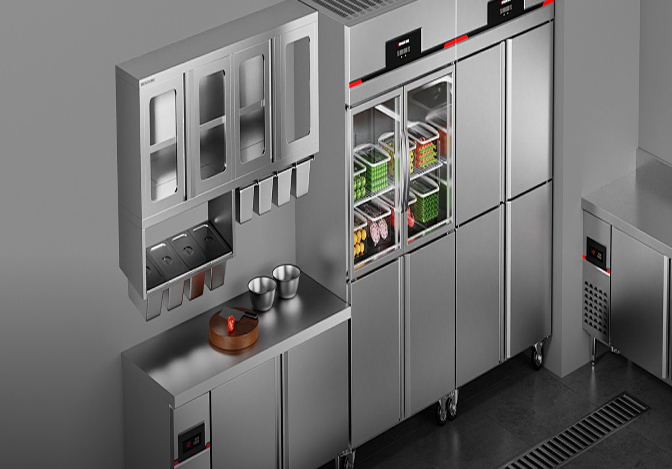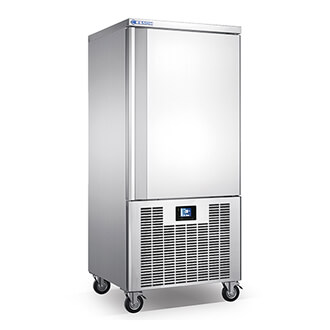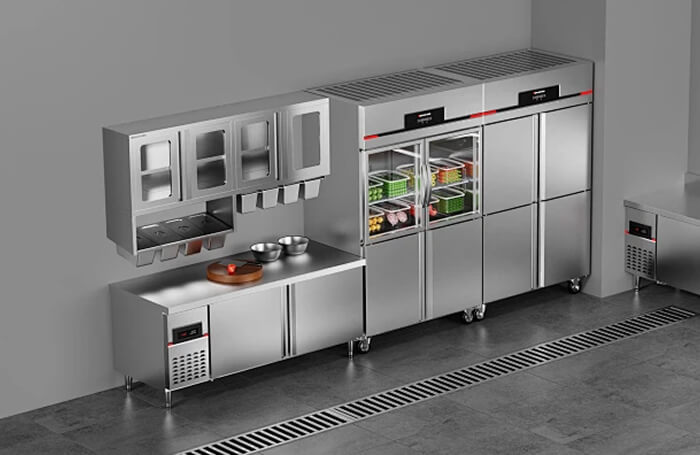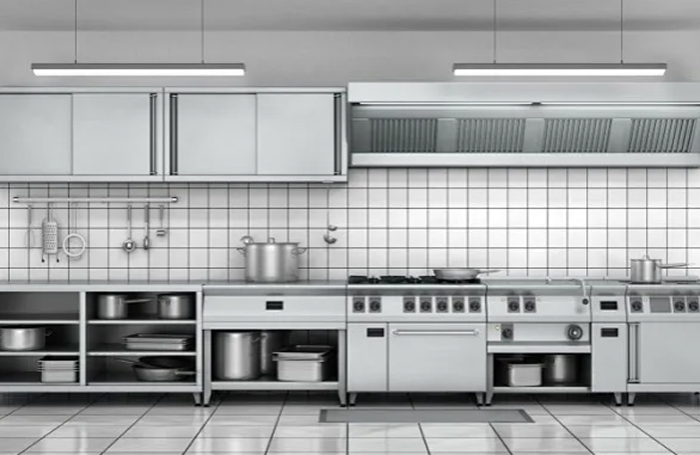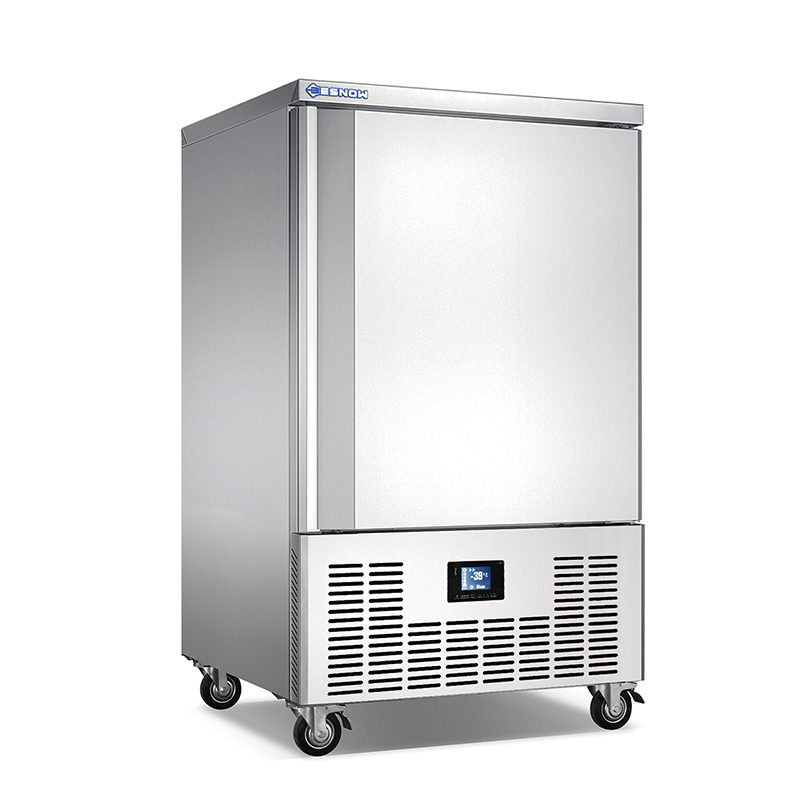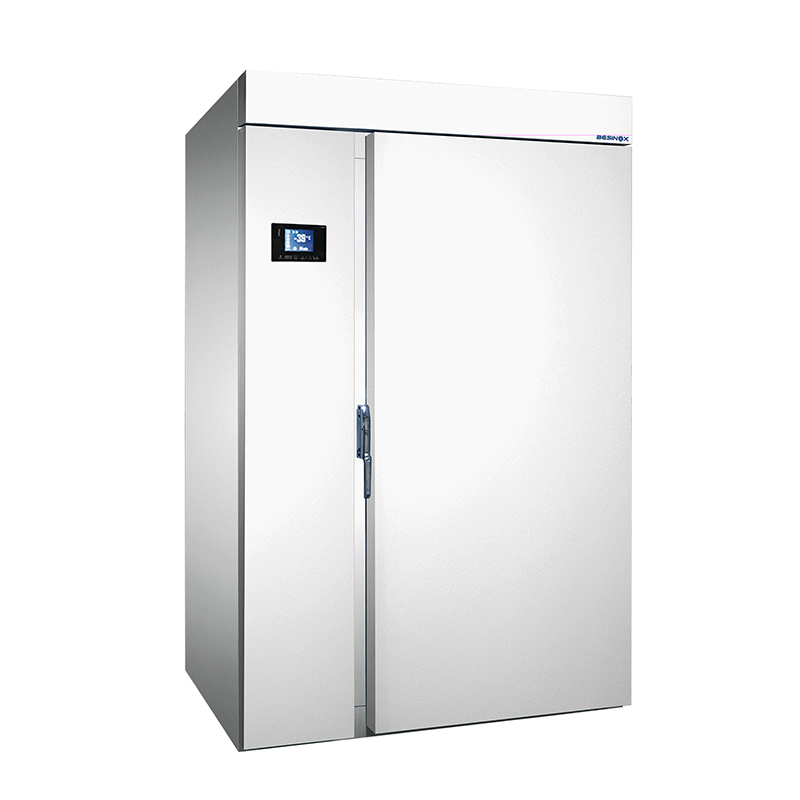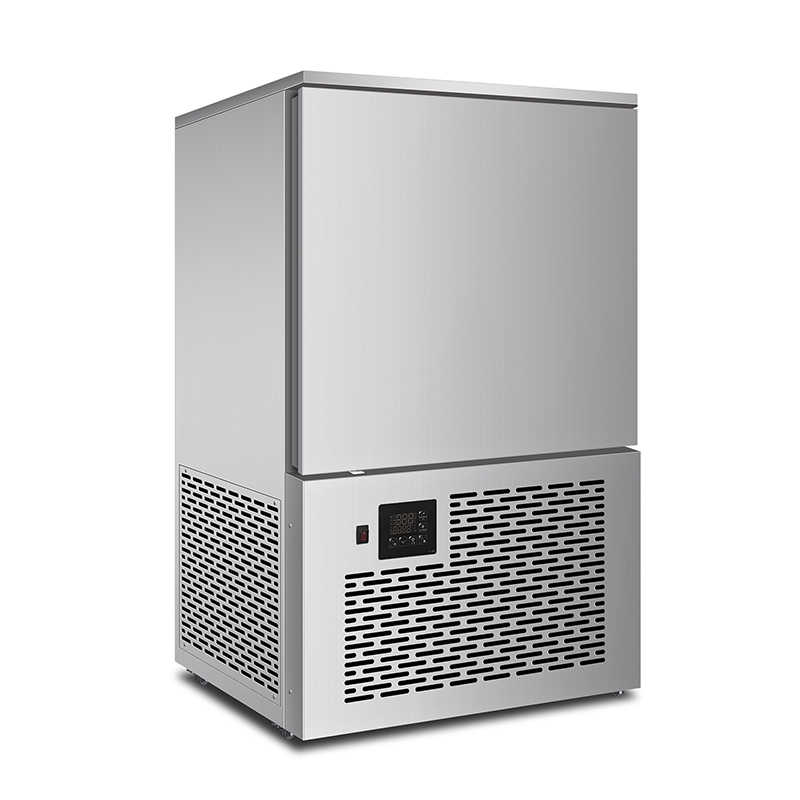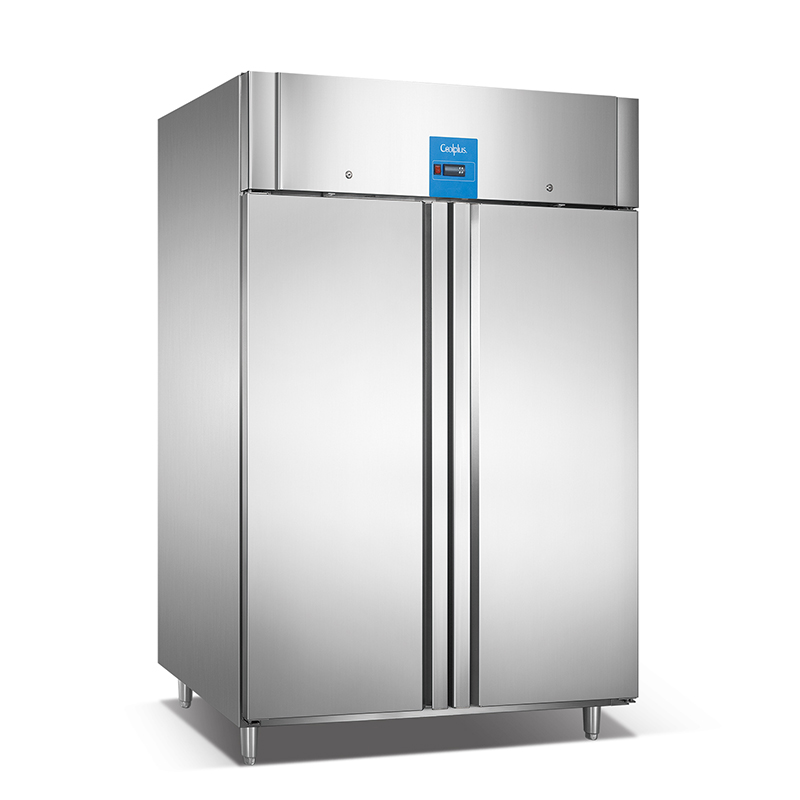
Blast freezer (also called as blast chiller, shock freezer, quick freezing cabinet or rapid freezing cabinet) is a refrigeration device that can rapidly cool food or other items to below their freezing point within a short period of time. Its core features are rapid cooling, high freezing efficiency, and the ability to better preserve the original quality of the items. It is widely used in various industries, with main applications including:
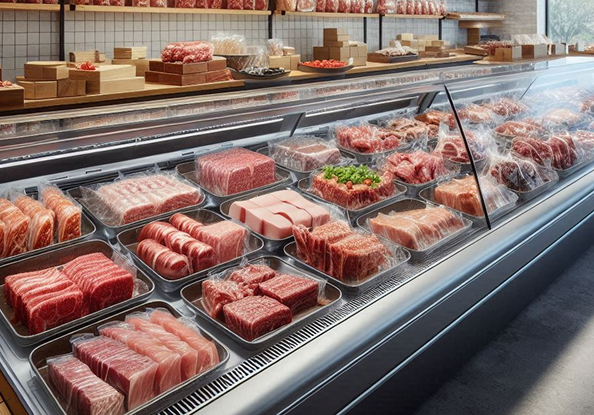
Meat/poultry processing: Used for rapid freezing after slaughter to prevent bacterial growth and maintain the tenderness of the meat.
Aquatic product processing: such as fish, shrimp, shellfish, etc., are quick-frozen immediately after being caught or farmed to lock in moisture and freshness.
Quick-frozen fruits and vegetables: Fruits (such as strawberries and blueberries) and vegetables (such as peas and corn kernels) are quick-frozen after pretreatment to extend their shelf life.
Prepared meals/central kitchens: Foods prepared in bulk need to be quickly frozen for delivery to ensure taste and safety.
Meat/poultry processing: Used for rapid freezing after slaughter to prevent bacterial growth and maintain the tenderness of the meat.
Aquatic product processing: such as fish, shrimp, shellfish, etc., are quick-frozen immediately after being caught or farmed to lock in moisture and freshness.
Quick-frozen fruits and vegetables: Fruits (such as strawberries and blueberries) and vegetables (such as peas and corn kernels) are quick-frozen after pretreatment to extend their shelf life.
Prepared meals/central kitchens: Foods prepared in bulk need to be quickly frozen for delivery to ensure taste and safety.
Meat/poultry processing: Used for rapid freezing after slaughter to prevent bacterial growth and maintain the tenderness of the meat.
Aquatic product processing: such as fish, shrimp, shellfish, etc., are quick-frozen immediately after being caught or farmed to lock in moisture and freshness.
Quick-frozen fruits and vegetables: Fruits (such as strawberries and blueberries) and vegetables (such as peas and corn kernels) are quick-frozen after pretreatment to extend their shelf life.
Prepared meals/central kitchens: Foods prepared in bulk need to be quickly frozen for delivery to ensure taste and safety.
Meat/poultry processing: Used for rapid freezing after slaughter to prevent bacterial growth and maintain the tenderness of the meat.
Aquatic product processing: such as fish, shrimp, shellfish, etc., are quick-frozen immediately after being caught or farmed to lock in moisture and freshness.
Quick-frozen fruits and vegetables: Fruits (such as strawberries and blueberries) and vegetables (such as peas and corn kernels) are quick-frozen after pretreatment to extend their shelf life.
Prepared meals/central kitchens: Foods prepared in bulk need to be quickly frozen for delivery to ensure taste and safety.
Meat/poultry processing: Used for rapid freezing after slaughter to prevent bacterial growth and maintain the tenderness of the meat.
Aquatic product processing: such as fish, shrimp, shellfish, etc., are quick-frozen immediately after being caught or farmed to lock in moisture and freshness.
Quick-frozen fruits and vegetables: Fruits (such as strawberries and blueberries) and vegetables (such as peas and corn kernels) are quick-frozen after pretreatment to extend their shelf life.
Prepared meals/central kitchens: Foods prepared in bulk need to be quickly frozen for delivery to ensure taste and safety.
Meat/poultry processing: Used for rapid freezing after slaughter to prevent bacterial growth and maintain the tenderness of the meat.
Aquatic product processing: such as fish, shrimp, shellfish, etc., are quick-frozen immediately after being caught or farmed to lock in moisture and freshness.
Quick-frozen fruits and vegetables: Fruits (such as strawberries and blueberries) and vegetables (such as peas and corn kernels) are quick-frozen after pretreatment to extend their shelf life.
Prepared meals/central kitchens: Foods prepared in bulk need to be quickly frozen for delivery to ensure taste and safety.
| Blast freezer | Blast freezer | |
| Freezing speed | From tens of minutes to 4 hours | From tens of minutes to 4 hours |
| Ice crystal form | Tiny ice crystals, a little or no damage to cell structure | Tiny ice crystals, a little or no damage to cell structure |
| Food Safety | Quickly inhibit bacterial growth | Quickly inhibit bacterial growth |
| Nutrition and taste | The cell structure is well preserved, and the nutrition and taste are closer to fresh ingredients | The cell structure is well preserved, and the nutrition and taste are closer to fresh ingredients |
The core value of blast freezers lies in "speed" and "freshness." They are suitable for scenarios with high requirements for food safety, quality, and shelf life, and are an indispensable key piece of equipment in modern catering services, food industry, and cold chain logistics.
1. High energy consumption
Quick-freezing cabinets can lower the temperature to -40°C or even lower in a very short time. They are equipped with high-power compressors and operate under high load for a long time, resulting in very high power consumption.
2. High equipment costs
High-performance freezers (such as liquid nitrogen freezers, spiral freezers, and air-cooled cryogenic freezers) are expensive.
3. Frosting and defrosting problems
Frequent door opening or high humidity environments can cause frost buildup on the evaporator, clogging air ducts and affecting cooling efficiency.
4. Poor temperature uniformity
Some blast freezers have poorly designed internal air duct structures, resulting in large temperature differences between different parts of the freezer.
5. Low space utilization
Some blast freezers have poorly designed refrigeration systems, with internal components such as evaporators and fans occupying a large amount of internal space.
6. Noise problem is prominent.
Some blast freezers have a large cooling capacity and require high-speed fans and high-power compressors, resulting in loud noise during operation. Some blast freezers are also not properly assembled, causing abnormally sharp noise due to vibration or resonance during operation.
7. Insufficient specialization in temperature control
Most blast freezers use ordinary freezer temperature controllers instead of professional blast freezer controllers, lacking the ability to control the blast freezing of different foods , which in turn affects the taste of the food.
8. Insufficient adaptability to application scenarios
Most general-purpose freezers cannot meet the needs of niche markets or specific application scenarios. For example, some seafood requires ultra-low temperature quick-freezing (down to -60℃), but general-purpose freezers only reach -40℃. For example, some bakeries' dough is afraid of drying out, but strong wind quick-freezing causes the surface to dehydrate and crack, affecting the appearance of the baked food.
By optimizing the product's air duct structure design, increasing the thickness and density of the insulation layer, using cold bridge broken door frame profiles, matching high COP compressors and environmentally friendly refrigerants, using series evaporators and energy-saving fans, and adopting professional temperature controllers for blast freezers, we can solve or optimize the above-mentioned industry pain points and bring customers higher product value and a better user experience.
It is compatible with different baking pan sizes in different regions, such as European baking pans which are 60x40cm and American baking pans which are 66x46cm.
For specific temperature requirements, the temperature can be customized to -30℃, -40℃, -60℃, or -80℃;
Specific quick-freezing capabilities, such as the number of baking trays, the number of trolleys, or the quick-freezing weight within a limited time, and whether it is a whole unit or separate units;
Specific application scenarios, such as blast freezers that only need to freeze seafood, ice cream, etc.
| Specific application scenarios | Customized form | Customize key parameters | quick-freezing ability | Custom product images |
| High-end frozen food for home us | Small tabletop freezer | -40℃, ≤60dB, ≤60L | 3~6kg/4h | |
| Central kitchen | trolley-type quick-freezing cabinet | -40℃, suitable for various ingredients, rapid antibacterial action | 100~150kg/4h | |
| Seafood/meat processing plants | Large-capacity walk-in freezer | -40℃, large capacity | 1000~2000kg per time | |
| Baking and pastry shop | Low-speed quick-freezing cabinet | Adjustable fan speed, high humidity | 20-40 discs/4 hours | |
| Medical research laboratory | Medical ultra-low temperature quick-freezing cabinet | -80℃ | 100-200L |
To visit Guangzhou BEU Electric Appliance Co., Ltd. (called as BEUEA below) website, you are agreeing the terms and conditions within this policy.
BEUEA respects your privacy and will protect your information remains confidential.
We will not lease, sell, or rent your information to the third party for their independent use under any circumstances.